


















Blueprint your revenue system like an architect blueprints a house.
See every platform, process, and handoff mapped visually.

The Systems Automation Engagements (SAE) Map reveals how your business actually operates. Most companies can’t answer: “Where does data break between Marketing and Sales?” or “Why do Operations build the wrong thing?” SAE shows you the answer — every system, every workflow, every gap highlighted in one visual map.

System Automation Engagements (SAE)

Visualize how your systems truly connect, revealing where data flows, stalls, or gets lost between teams.

Stop losing deals in the handoff between Sales, Ops, and CS. QDF moves data and triggers actions between systems instantly.

Your sales team closes a deal. Finance doesn’t see it for 3 days. Operations builds the wrong thing. Customer Success never gets the handoff. Quick Data Flow (QDF) fixes this — data flows between systems in real-time, without custom code that breaks when platforms update.

Workflow Automation

Turn every manual process into motion — connect systems, trigger actions, and let automation carry your revenue forward.

When every system tells a different story, nobody can make confident decisions. CDHS unifies CRM, ERP, Finance, and Ops into one real-time data layer and Single Source of Truth.

Your CRM says one thing. ERP says another. Finance is running reports from spreadsheets. Nobody trusts the data. The Centralized Data Hub System (CDHS) is your Single Source of Truth (SSOT) — real-time sync across every platform, governed data, and one unified view that actually works.

CDHS: How it Works?

Bring your data together in one place. It’s built to sync in real-time, link, and deliver insights you can use tomorrow.

Pre-built campaign automation kits, deploy customer engagement workflows without custom development.

Automation Campaigns Creator (ACC) provides pre-built engagement workflow kits designed to address specific areas of revenue leakage. Each ACC KIT includes campaign architecture, automation sequences, and multi-channel touchpoints — ready to deploy without custom development.

Automation Campaigns Creator (ACC)

Transform your Customer Engagement Journey with ACCs’ KITs intuitive automation tools.

Capture Decisions, Assign Tasks, and Keep Work Moving Without Manual Follow-Ups

Teams leave meetings with good intentions, but follow-through breaks down. Notes scatter across Slack. Action items disappear into documents. TALK-to-TASKS closes the execution gap — turn meeting recordings into correctly routed tasks automatically.

How TALK-to-TASKS Works?

Routing conversations from meetings with two clicks into the right place to the right person on your Project Tool.

Connecting systems is a solved problem. Governing the decisions inside them is not. The Decision Routing Cockpit is where the rules that run your revenue business finally live in one governed layer.

Right now those rules live in four places at once. A workflow no one owns, a spreadsheet no one updates, a script only one contractor reads, and the head of the person who remembers. The Decision Routing Cockpit (DRC) pulls all of them into one governed layer, with global defaults, per-case overrides, and every change audited six ways.

How Does It Work?

Every rule your revenue business runs on becomes named, scoped, and auditable. By the business, without a developer touching code.

Data Flow Architecture Design

Built from your SAE Map, we design workflows that connect systems and trigger the right actions at the right time.

Integration Path Selection

We choose the optimal path—native connectors, APIs, iPaaS (Make, Workato), or N8N—for reliable, scalable data flow.

Team Training & Documentation

We onboard your team, document workflows, and ensure everyone knows how the system works.

We design and build QDFs that move data and trigger actions across your systems in real-time.

You need workflows that don’t break when platforms update. We implement Quick Data Flows using your SAE Map as the blueprint—connecting CRM, ERP, operations, and finance so every action flows automatically without custom code that breaks on the next update.

CDHS Architecture Design

Built from your SAE Map, we design the central hub that connects all systems and establishes your single source of truth.

Master Data Management (MDM)

We establish control and accuracy across every record, ensuring clean, consistent, reliable data everywhere.

Data Governance & Flow Rules

We define ownership, validation rules, and automated flow logic to keep your data clean as it scales.

We implement CDHS so every system, report, and decision runs from one source of truth.

When CRM, ERP, Finance, and Operations all tell different stories, nobody can make confident decisions. We build your Centralized Data Hub System using your SAE Map to define data ownership, flow rules, and governance—so you finally have one real-time view that everyone trusts.

Campaign Strategy & Journey Mapping

We map your customer journey, identify engagement gaps, and design campaigns that address specific revenue leakage points.

Multi-Channel Workflow Design

We design coordinated workflows across email, SMS, in-app messaging, and sales triggers for unified engagement.

Campaign Launch & Optimization

We build, test, launch, and continuously optimize your campaigns for maximum conversion and engagement.

We design and deploy multi-channel engagement campaigns using ACC templates—customized for your customer journey.

Generic email sequences don’t work. We build Automation Campaign Creator (ACC) workflows tailored to your specific revenue leakage points—combining email, SMS, in-app, and sales triggers across HubSpot, Klaviyo, and your CRM to drive engagement that converts.

Integration Architecture & Path Design

Selecting the optimal path for seamless, scalable data flow across Departments.

Custom Implementation & Config

From simple plug-ins to advanced cross-system builds, we tailor each setup to your business logic.

Mastering Seamless Migration & Implementation Systems

Your new tools integrate smoothly, align with your workflows, and start delivering value from day one.

We don't just connect systems, we make them work in harmony. Fruition designs, builds, and implements integrations that keep your operations flowing without friction.

Most integrations are duct-taped APIs that break when platforms update. We design integration architecture for the long term—selecting the optimal path through native connectors, APIs, N8N, or iPaaS like Make or Workato.

15-minute conversation that reveals where your revenue system breaks — gaps, silos, missed handoffs mapped visually.

Most companies can’t answer basic questions: “Where does our sales data break?” “Why doesn’t Operations know what Marketing promised?” The SAE Diagnostic reveals your answer in 15 minutes — a visual map showing exactly where systems disconnect, data gets lost, and revenue leaks.

System Automation Engagements (SAE)

Visualize your business blueprint. See every system, process, and touchpoint in one place.

Stop Revenue Leakage

Find and fix the invisible cracks draining your time, money, and margins — before they turn into growth barriers.

Preventing your Data Silos — Get your SSOT

Centralize scattered data and replace confusion with clarity, ensuring every department works from one truth of data and build your single source of truth (SSOT).

Process Mapping & Documentation

We map how work truly gets done across RevOps, Production, and Operations — turning chaos into structured processes.

SOP Design for Automation Readiness

Every SOP is built with automation in mind, ensuring systems and people work together. Not against each other.

Adoption & Change Enablement

We don't just document; we drive adoption. Teams learn how to follow, improve, and trust the process, turning SOPs into muscle memory.

Transform tribal knowledge into repeatable workflows, giving your teams the structure to scale with clarity and consistency.

Automation breaks and centralization stalls when teams work from memory instead of process. We map how work truly gets done — turning SOPs into muscle memory, not shelfware.

Team Training & Enablement

Hands-on training sessions tailored to your team's roles, ensuring everyone uses new systems confidently from day one.

Adoption Measurement & Optimization

Track adoption metrics, identify blockers, and continuously optimize workflows to ensure your team actually uses what you built.

Gold Partner Implementation Support

We're Gold Partners with HubSpot, Monday.com, and Segment — meaning we bring certified expertise to every implementation.

We don't just hand over systems — we onboard your team, train them to use tools confidently, and ensure adoption sticks.

New systems fail when teams don’t adopt them. We train, enable, and support your team through the transition. As Gold Partners with HubSpot, Monday.com, and Segment, we know how to make systems work for your people.

RevOps Strategy & System Architecture

We align your go-to-market strategy with your tech stack, designing the operational backbone that connects Marketing, Sales, and CS.

Performance & Optimization with Automation Support by AI agent

Our consultants analyze your funnel, uncover hidden inefficiencies, and rebuild your operations for precision, speed, and scalability.

Tech Stack Alignment & Implementation

From HubSpot and NetSuite to Monday.com and Shipwell, we integrate and orchestrate your tech ecosystem into one coordinated revenue engine.

Strategic advisory for revenue operations — system architecture, automation strategy, data governance, and team enablement.

RevOps isn’t just about connecting systems — it’s about aligning strategy, data, and execution. Our consultants bring two decades of experience building revenue engines for $50M-$500M companies.

The LET DATA FLOW™ Framework

Fruition RevOps’ proven framework turns disconnected systems into synchronized revenue engines. Each stage reveals where your data, workflows, and teams fall out of sync, and rebuilds them into one intelligent flow that drives efficiency, visibility, and growth.
Four stages that guarantee smooth process alignment

1

Diagram Your SAE Map

Map how your business actually operates across teams, capturing the customer journey, decision points, system roles, data handoffs, and revenue flow. This blueprint surfaces inefficiencies and defines what must be automated versus redesigned.

2

Map Your Data & Automation Attributes

Translate the SAE blueprint into a concrete data flow and automation model — defining system ownership, data attributes, relationships, and trigger logic. This prepares your foundation before building QDFs.

3

Centralize the Flow (CDHS)

Implement the Centralized Data Hub System as the governance layer connecting all systems and QDFs. CDHS enforces data ownership, flow rules, and establishes a single source of truth — ensuring automation stays stable as you scale.

4

Build & Execute Data Flow (QDF)

Deploy targeted Quick Data Flows that move data and trigger actions across systems in real time. Each QDF handles a specific business event — deal progression, order creation, production updates, billing changes — without manual intervention.

Manufacturing

Sync production schedules, inventory, and order fulfillment across ERP, CRM, and operations.

Healthcare

Connect patient data, billing, and care coordination across EMR, RCM, and operations systems.

Technology

Align product, engineering, sales, and customer success with real-time data across tools.

Consumer Services

Unify ticketing, CRM, and knowledge bases to deliver seamless customer experiences at scale.

Retail

Connect POS, inventory, e-commerce, and fulfillment for real-time visibility across channels.

Franchisors

Centralize franchise operations, royalty tracking, and performance reporting across locations.

Agencies

Sync project management, client billing, and team capacity across tools for better margins.

Investments

Unify portfolio tracking, deal flow, and LP reporting for complete investment oversight.

Meet Our Team

The automation architects, data specialists, and RevOps consultants behind Fruition.

Our History

Two decades transforming disconnected systems into unified revenue engines.

Partner With Fruition

Join our network of agencies and consultants implementing Fruition frameworks.

Our Philosophy

Where technology meets process—aligning Platforms, People, Processes, and Insights.

Resources & Learning

Latest Blog Posts

Stay current with RevOps insights and automation strategies

VideoTube Channel

Watch automation tutorials and implementation guides

Free RevOps Evaluation

Assess your revenue operations maturity

ACC Templates

Pre-built automation campaign kits ready to deploy

Framework Guide

Learn the Let Data Flow methodology step-by-step

Contact Our Team

Talk to automation architects about your systems

Case Studies

Real implementations with measurable results

Tools & Calculators

Revenue Leakage Calculator and diagnostic tools

Start Here Page

Not sure where to begin? We’ll guide you.

Why Data Flow

Most RevOps fixes treat the symptom. This is how we fix the operating model underneath.

Data Leakage Calculator

Find out how much revenue your business is losing and exactly where it’s slipping through the cracks.

Pricing

Every engagement follows a logical journey. Here’s where it starts.

SAE Architecture Map

Find where your revenue is breaking — every engagement starts here. We map your systems, identify leakage points, and show you exactly what to fix first.

Which Enterprise Architecture Software Providers Have Strong Customer Support for Onboarding?
The enterprise architecture (EA) software providers with the strongest customer support for onboarding right now include SAP LeanIX, Orbus Software, Bizzdesign, Ardoq, Avolution, Sparx Systems, and erwin Evolve. Support quality differs sharply between them. Even the best onboarding program only gets your architects comfortable with the tool, and the model it produces is still only as accurate as the system data behind it.
An EA platform maps the applications, integrations, and data flows a company runs on, and turns that map into something leadership can use to plan a migration, a merger, or a cost cut without guessing. Good onboarding support decides how fast your architects get comfortable in the tool. Whether the information going into the model is current, complete, and trusted by the people who have to act on it is a separate question, and it’s the one this post comes back to.
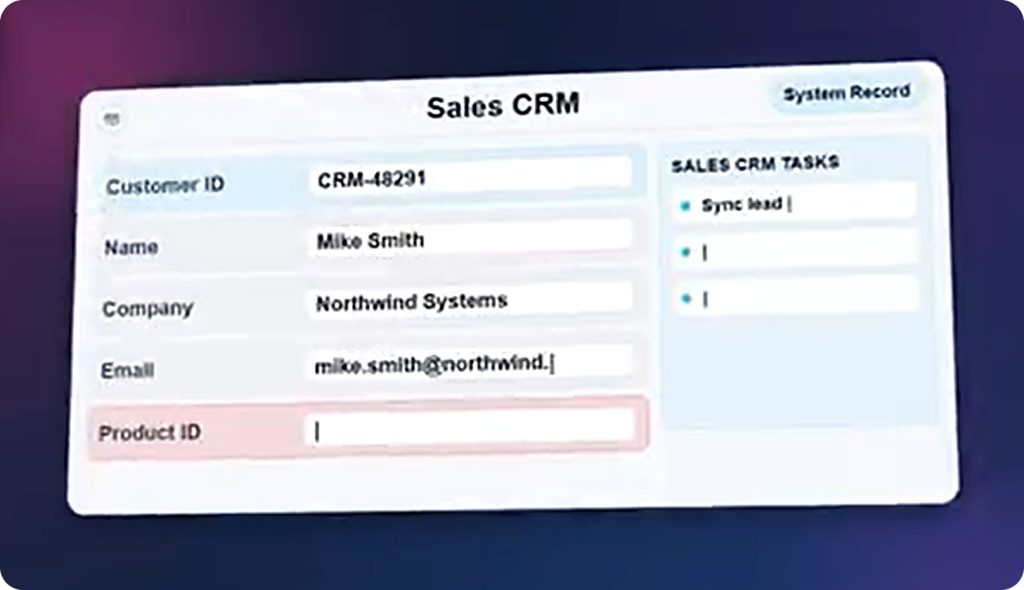
Enterprise architecture software depends on complete system data, shown by a CRM record with a missing product ID

The Enterprise Architecture Software Providers With Strong Onboarding Support
Right Now

Every shortlist in this category ends up sorting the same handful of platforms by company size, budget, and how hands-on the support needs to be during the first few months. The field looks like this right now, described plainly and in no particular order.
PlatformOnboarding styleWorth knowing
SAP LeanIXPublished three-phase onboarding path and a Customer Success team4.5 out of 5 on G2 (191 reviews)
Orbus SoftwareTemplates and guided solutions, built around Microsoft 365Leader in the 2025 Gartner Magic Quadrant
BizzdesignLarge, established vendor covering several product linesMerged with MEGA and acquired Alfabet
ArdoqFlexible metamodel with a steeper learning curve4.5 out of 5 on G2 (33 reviews)
AvolutionScales from one architect to the whole enterpriseLeader in the 2025 Gartner Magic Quadrant
Sparx SystemsLargely self-serveNiche Player in the 2025 Gartner Magic Quadrant
erwin EvolveEA combined with business process modelingNot evaluated in the 2025 Gartner Magic Quadrant

SAP LeanIX: Best for a Documented Onboarding Path

SAP LeanIX publishes a three-phase onboarding path that moves from getting started, to adding the first data to the workspace, to getting stakeholders on board. SAP LeanIX says customers are up and running within three to four months, compared with up to twelve months for first-generation EA tools, and credits a framework built from more than 180 customer implementations. A dedicated Customer Success team stays involved after go-live. On G2, the product holds a 4.5 out of 5 rating across 191 reviews, and several reviewers call out fast, responsive support.

Orbus Software: Best for Companies Running on Microsoft 365

Orbus Software’s OrbusInfinity builds its pitch around time to value, with more than 70 templated self-service and guided solutions, plus framework templates designed to shorten the learning curve. Orbus was named a Leader in the October 2025 Gartner Magic Quadrant for Enterprise Architecture Tools, one of six vendors to earn that placement, and points to its Gartner Peer Insights reviews as evidence of customer satisfaction. OrbusInfinity integrates natively with Microsoft Teams, SharePoint, Power BI, and Power Automate, which cuts down on setup work for architects who already work in those tools every day.

Bizzdesign: Best for Broad Coverage Across Several Product Lines

Bizzdesign brought three long-standing EA vendors under one brand, merging with MEGA International in September 2024 and acquiring Alfabet from Software AG in January 2025. The combined company serves roughly 2,000 customers and keeps the acquired product lines running, including Alfabet and MEGA’s HOPEX, alongside its own Horizzon platform and the newer Bizzdesign Unify. If your company would be on one of the folded-in product lines, ask how support for that product works inside the combined company, since the merger is still recent.

Ardoq: Best for Flexible, Customizable Models

Ardoq targets large, complex organizations, with customers such as ExxonMobil, Carlsberg Group, and BT on its site, and it holds a 4.5 out of 5 rating on G2 across 33 reviews. Its support reviews are more mixed than SAP LeanIX’s. Some reviewers describe Ardoq’s customer service as the highest standard they’ve seen, while others list poor support among their complaints. Several also flag a steep learning curve that comes with Ardoq’s flexible metamodel. One reviewer warned that “without proper onboarding and governance, models can become inconsistent across teams.” In 2024, Ardoq also brought on the team behind ShiftX, a process visualization company.

Avolution: Best for Scaling From One Architect to the Enterprise

Avolution’s ABACUS platform scales from a single architect’s first model up to enterprise-wide deployments, and Avolution was named a Leader in the 2025 Gartner Magic Quadrant alongside Ardoq, Bizzdesign, BOC Group, Orbus Software, and SAP LeanIX. Avolution publishes less public detail about onboarding timelines and support than the other Leaders on this list. If support depth is the deciding factor, ask Avolution for specifics directly, since there’s less third-party data to weigh.

Sparx Systems: Best for Individual Architects and Small Workgroups

Sparx Systems’ Enterprise Architect is the outlier on this list by design. It’s sold as licenses for individual architects and workgroups across four editions, and onboarding is largely self-serve, built on guided tours, a large pattern library, documentation, and a user forum. Gartner placed Sparx Systems as a Niche Player in its 2025 Magic Quadrant, which fits a tool built for lower cost and broad individual use.

erwin Evolve: Best for EA Combined With Process Modeling

erwin Evolve, owned by Quest Software, combines enterprise architecture with business process modeling and supports frameworks like TOGAF and ArchiMate. Quest doesn’t publish specific onboarding timelines or independent support ratings for Evolve, and the product wasn’t among the fourteen vendors Gartner evaluated in its 2025 Magic Quadrant for Enterprise Architecture Tools. There’s less outside evidence to weigh here, so if onboarding support is the deciding factor, ask Quest for customer references directly.

That list covers the realistic shortlist for enterprise architecture software this year, from the deeply resourced SAP LeanIX and Bizzdesign platforms to the self-serve Sparx Systems option at the other end.

Good onboarding gets your architects using the tool. Whether the model reflects how your systems actually work is a different question.

Why Strong Onboarding Support Doesn't Guarantee a Reliable Architecture Model

A smooth rollout and an accurate model are two different outcomes, and a vendor’s support organization controls only the first one.

Onboarding Gets You a Working Model

Onboarding support, even the best of it, walks architects through structuring the tool, including the taxonomy, the views, and who owns which layer of the model. The platform still can’t tell whether the application inventory being filled in is current, whether the system owners interviewed during setup know about every undocumented integration, or whether a business unit’s shadow IT stack made it into the picture at all. The architecture model is only as current as the information keyed into it after onboarding ends, and most EA programs lean on the same handful of people to keep it fresh. An automated data flow between the systems feeding the model catches that drift as it happens, so nobody has to wait for the next review cycle to notice the picture has gone stale.

The Enterprise Architecture Software Market Is Consolidating Fast

The EA software market brought three long-standing vendors together under one brand in a matter of months, and Gartner’s October 2025 Magic Quadrant notes that larger, well-resourced vendors are growing revenue and customer base faster, often at the expense of smaller competitors. Picking a platform mid-consolidation carries the same risk here that it does in other enterprise software categories. The support contact your organization onboarded with may not be the one answering tickets two years from now.

What Makes an Architecture Model Worth Trusting

Any EA tool on the shortlist depends on the customer relationship management (CRM), enterprise resource planning (ERP), cloud inventory, and ticketing data it pulls its picture from. A single source of truth for that underlying system and application data keeps the architecture model accurate between formal review cycles, so it stays current long after the day onboarding wrapped up.

Signs Your Onboarding Problem Is a Data Problem

You can find out whether the real gap sits with the vendor or with your own data without re-running an enterprise architecture software evaluation. The symptoms tend to show up inside the model itself, long before anyone files a support ticket.

The Application Inventory Never Matches What IT Runs

If the architecture model lists systems that were retired two reorganizations ago, or is missing a cloud service a business unit spun up without telling anyone, that gap exists regardless of which vendor walked your architects through setup.

Every Model Update Depends on One Person's Memory

When updating the architecture model means pinging the one architect who remembers how a given integration works, the tool is only as durable as that person’s calendar. A governed decision layer that records who changed a rule, when, and why keeps that history intact after the person who built it moves on.

The Model Looks Finished but Nobody Trusts It Enough to Use It

A model that took months to build and gets ignored during a real planning decision usually wasn’t built on data the business already trusted. An onboarding program can’t fix that after the fact.

Fix the System Data Behind Your Model Before You Pick a Vendor

Onboarding support still matters. The data feeding the model needs attention first, or the best onboarding program on this list produces a more organized version of the same inaccurate picture.

1. Map Your System Landscape First

Before comparing enterprise architecture software, map the systems, integrations, and data flows your organization runs today, including the ones a diagram from two years ago would miss. The System Automation Engagement (SAE) Map gives you a structured way to lay that groundwork before a vendor’s onboarding specialists get involved.

2. Fix the Worst Data Gap First

Once the map shows where the picture breaks down, whether that’s a system nobody documented or a handoff still running on a spreadsheet, fix that one connection before signing an EA platform contract. A Quick Data Flow (QDF) can close a single data gap and show whether the underlying problem was ever about software at all.

3. Keep CRM, ERP, and the Architecture Model Reading From the Same Data

A governed data hub hub that keeps CRM, ERP, and operational systems aligned keeps an architecture model from drifting the moment a process changes, so it doesn’t have to wait for the next formal review cycle to catch up. That risk shows up most at the ERP layer, where direct point-to-point connections tend to fail silently after a platform update, long before anyone notices the model no longer matches reality.

Common Questions About Enterprise Architecture Software and Onboarding Support

Which Enterprise Architecture Software Has the Best Onboarding Support?
SAP LeanIX publishes the most detailed onboarding framework of the group and backs it with the strongest independent review data, including a 4.5 out of 5 G2 rating across 191 reviews. That makes it the best-documented option. The best fit for your company still depends on your size and budget.
SAP LeanIX is the original LeanIX. SAP completed its acquisition of LeanIX in November 2023, and the product now operates under the SAP LeanIX name.
Both are now part of Bizzdesign. Bizzdesign merged with MEGA International in September 2024 and acquired Alfabet from Software AG in January 2025, and both product lines continue under the Bizzdesign brand.
It depends on how many architects you have and how much hands-on support the rollout needs. Sparx Systems’ Enterprise Architect works well for individual architects and smaller workgroups on a self-serve model. Platforms like SAP LeanIX, Orbus Software, and Bizzdesign suit organizations that need dedicated onboarding specialists and ongoing customer success support.
Look at whether the architecture model still matches what IT runs, and whether updating it depends on one person’s memory instead of a repeatable process. If either answer is yes, a new enterprise architecture software purchase inherits that gap. A revenue diagnostic is a good place to talk through where that gap starts before you commit to a new platform.

See Where Your Architecture Data Breaks Down

Before you shortlist new enterprise architecture software, take a closer look at how system data moves into the model you already have.

Schedule a Time with our Expert!

— Fill out the Form and let's meet —

Fill out the form below to book your meeting to get your HubSpot Audit Report.

Schedule a meeting
Your HubSpot Onboarding Plan.

** Schedule to have you High level plan for free.

Funnel Types List

Register and Get the Funnel List type

Provide you with a complete overview of the type of funnel and how to manage it. 

JOIN OUR LIVE EVENT!

Wednesday, October 18th
10AM (PST)

Webinar Topic: Fix the Leak with Streamline Your Revenue Path with RevOps Funnels. 
How to seamlessly guide prospects through your company’s journey,

  1. Utilize the Funnels in Revenue Operations
  2. How to Prevent Bleeding Prospects and Customers in Your Company’s Journey
  3. How to Automate the Process for Enhanced Efficiency

RevOps Knowledge Sharing!

Fill out the form below, and blogs, videos and content will come directly to your inbox.