














Blueprint your revenue system like an architect blueprints a house.
See every platform, process, and handoff mapped visually.

The Systems Automation Engagements (SAE) Map reveals how your business actually operates. Most companies can’t answer: “Where does data break between Marketing and Sales?” or “Why do Operations build the wrong thing?” SAE shows you the answer — every system, every workflow, every gap highlighted in one visual map.

System Automation Engagements (SAE)

Visualize how your systems truly connect, revealing where data flows, stalls, or gets lost between teams.

Stop losing deals in the handoff between Sales, Ops, and CS. QDF moves data and triggers actions between systems instantly.

Your sales team closes a deal. Finance doesn’t see it for 3 days. Operations builds the wrong thing. Customer Success never gets the handoff. Quick Data Flow (QDF) fixes this — data flows between systems in real-time, without custom code that breaks when platforms update.

Workflow Automation

Turn every manual process into motion — connect systems, trigger actions, and let automation carry your revenue forward.

When every system tells a different story, nobody can make confident decisions. CDHS unifies CRM, ERP, Finance, and Ops into one real-time data layer and Single Source of Truth.

Your CRM says one thing. ERP says another. Finance is running reports from spreadsheets. Nobody trusts the data. The Centralized Data Hub System (CDHS) is your Single Source of Truth (SSOT) — real-time sync across every platform, governed data, and one unified view that actually works.

CDHS: How it Works?

Bring your data together in one place. It’s built to sync in real-time, link, and deliver insights you can use tomorrow.

Pre-built campaign automation kits, deploy customer engagement workflows without custom development.

Automation Campaigns Creator (ACC) provides pre-built engagement workflow kits designed to address specific areas of revenue leakage. Each ACC KIT includes campaign architecture, automation sequences, and multi-channel touchpoints — ready to deploy without custom development.

Automation Campaigns Creator (ACC)

Transform your Customer Engagement Journey with ACCs’ KITs intuitive automation tools.

Capture Decisions, Assign Tasks, and Keep Work Moving Without Manual Follow-Ups

Teams leave meetings with good intentions, but follow-through breaks down. Notes scatter across Slack. Action items disappear into documents. TALK-to-TASKS closes the execution gap — turn meeting recordings into correctly routed tasks automatically.

How TALK-to-TASKS Works?

Routing conversations from meetings with two clicks into the right place to the right person on your Project Tool.

Connecting systems is a solved problem. Governing the decisions inside them is not. The Decision Routing Cockpit is where the rules that run your revenue business finally live in one governed layer.

Right now those rules live in four places at once. A workflow no one owns, a spreadsheet no one updates, a script only one contractor reads, and the head of the person who remembers. The Decision Routing Cockpit (DRC) pulls all of them into one governed layer, with global defaults, per-case overrides, and every change audited six ways.

How Does It Work?

Every rule your revenue business runs on becomes named, scoped, and auditable. By the business, without a developer touching code.

Data Flow Architecture Design

Built from your SAE Map, we design workflows that connect systems and trigger the right actions at the right time.

Integration Path Selection

We choose the optimal path—native connectors, APIs, iPaaS (Make, Workato), or N8N—for reliable, scalable data flow.

Team Training & Documentation

We onboard your team, document workflows, and ensure everyone knows how the system works.

We design and build QDFs that move data and trigger actions across your systems in real-time.

You need workflows that don’t break when platforms update. We implement Quick Data Flows using your SAE Map as the blueprint—connecting CRM, ERP, operations, and finance so every action flows automatically without custom code that breaks on the next update.

CDHS Architecture Design

Built from your SAE Map, we design the central hub that connects all systems and establishes your single source of truth.

Master Data Management (MDM)

We establish control and accuracy across every record, ensuring clean, consistent, reliable data everywhere.

Data Governance & Flow Rules

We define ownership, validation rules, and automated flow logic to keep your data clean as it scales.

We implement CDHS so every system, report, and decision runs from one source of truth.

When CRM, ERP, Finance, and Operations all tell different stories, nobody can make confident decisions. We build your Centralized Data Hub System using your SAE Map to define data ownership, flow rules, and governance—so you finally have one real-time view that everyone trusts.

Campaign Strategy & Journey Mapping

We map your customer journey, identify engagement gaps, and design campaigns that address specific revenue leakage points.

Multi-Channel Workflow Design

We design coordinated workflows across email, SMS, in-app messaging, and sales triggers for unified engagement.

Campaign Launch & Optimization

We build, test, launch, and continuously optimize your campaigns for maximum conversion and engagement.

We design and deploy multi-channel engagement campaigns using ACC templates—customized for your customer journey.

Generic email sequences don’t work. We build Automation Campaign Creator (ACC) workflows tailored to your specific revenue leakage points—combining email, SMS, in-app, and sales triggers across HubSpot, Klaviyo, and your CRM to drive engagement that converts.

Integration Architecture & Path Design

Selecting the optimal path for seamless, scalable data flow across Departments.

Custom Implementation & Config

From simple plug-ins to advanced cross-system builds, we tailor each setup to your business logic.

Mastering Seamless Migration & Implementation Systems

Your new tools integrate smoothly, align with your workflows, and start delivering value from day one.

We don't just connect systems, we make them work in harmony. Fruition designs, builds, and implements integrations that keep your operations flowing without friction.

Most integrations are duct-taped APIs that break when platforms update. We design integration architecture for the long term—selecting the optimal path through native connectors, APIs, N8N, or iPaaS like Make or Workato.

15-minute conversation that reveals where your revenue system breaks — gaps, silos, missed handoffs mapped visually.

Most companies can’t answer basic questions: “Where does our sales data break?” “Why doesn’t Operations know what Marketing promised?” The SAE Diagnostic reveals your answer in 15 minutes — a visual map showing exactly where systems disconnect, data gets lost, and revenue leaks.

System Automation Engagements (SAE)

Visualize your business blueprint. See every system, process, and touchpoint in one place.

Stop Revenue Leakage

Find and fix the invisible cracks draining your time, money, and margins — before they turn into growth barriers.

Preventing your Data Silos — Get your SSOT

Centralize scattered data and replace confusion with clarity, ensuring every department works from one truth of data and build your single source of truth (SSOT).

Process Mapping & Documentation

We map how work truly gets done across RevOps, Production, and Operations — turning chaos into structured processes.

SOP Design for Automation Readiness

Every SOP is built with automation in mind, ensuring systems and people work together. Not against each other.

Adoption & Change Enablement

We don't just document; we drive adoption. Teams learn how to follow, improve, and trust the process, turning SOPs into muscle memory.

Transform tribal knowledge into repeatable workflows, giving your teams the structure to scale with clarity and consistency.

Automation breaks and centralization stalls when teams work from memory instead of process. We map how work truly gets done — turning SOPs into muscle memory, not shelfware.

Team Training & Enablement

Hands-on training sessions tailored to your team's roles, ensuring everyone uses new systems confidently from day one.

Adoption Measurement & Optimization

Track adoption metrics, identify blockers, and continuously optimize workflows to ensure your team actually uses what you built.

Gold Partner Implementation Support

We're Gold Partners with HubSpot, Monday.com, and Segment — meaning we bring certified expertise to every implementation.

We don't just hand over systems — we onboard your team, train them to use tools confidently, and ensure adoption sticks.

New systems fail when teams don’t adopt them. We train, enable, and support your team through the transition. As Gold Partners with HubSpot, Monday.com, and Segment, we know how to make systems work for your people.

RevOps Strategy & System Architecture

We align your go-to-market strategy with your tech stack, designing the operational backbone that connects Marketing, Sales, and CS.

Performance & Optimization with Automation Support by AI agent

Our consultants analyze your funnel, uncover hidden inefficiencies, and rebuild your operations for precision, speed, and scalability.

Tech Stack Alignment & Implementation

From HubSpot and NetSuite to Monday.com and Shipwell, we integrate and orchestrate your tech ecosystem into one coordinated revenue engine.

Strategic advisory for revenue operations — system architecture, automation strategy, data governance, and team enablement.

RevOps isn’t just about connecting systems — it’s about aligning strategy, data, and execution. Our consultants bring two decades of experience building revenue engines for $50M-$500M companies.

The LET DATA FLOW™ Framework

Fruition RevOps’ proven framework turns disconnected systems into synchronized revenue engines. Each stage reveals where your data, workflows, and teams fall out of sync, and rebuilds them into one intelligent flow that drives efficiency, visibility, and growth.
Four stages that guarantee smooth process alignment

1

Diagram Your SAE Map

Map how your business actually operates across teams, capturing the customer journey, decision points, system roles, data handoffs, and revenue flow. This blueprint surfaces inefficiencies and defines what must be automated versus redesigned.

2

Map Your Data & Automation Attributes

Translate the SAE blueprint into a concrete data flow and automation model — defining system ownership, data attributes, relationships, and trigger logic. This prepares your foundation before building QDFs.

3

Centralize the Flow (CDHS)

Implement the Centralized Data Hub System as the governance layer connecting all systems and QDFs. CDHS enforces data ownership, flow rules, and establishes a single source of truth — ensuring automation stays stable as you scale.

4

Build & Execute Data Flow (QDF)

Deploy targeted Quick Data Flows that move data and trigger actions across systems in real time. Each QDF handles a specific business event — deal progression, order creation, production updates, billing changes — without manual intervention.

Manufacturing

Sync production schedules, inventory, and order fulfillment across ERP, CRM, and operations.

Healthcare

Connect patient data, billing, and care coordination across EMR, RCM, and operations systems.

Technology

Align product, engineering, sales, and customer success with real-time data across tools.

Consumer Services

Unify ticketing, CRM, and knowledge bases to deliver seamless customer experiences at scale.

Retail

Connect POS, inventory, e-commerce, and fulfillment for real-time visibility across channels.

Franchisors

Centralize franchise operations, royalty tracking, and performance reporting across locations.

Agencies

Sync project management, client billing, and team capacity across tools for better margins.

Investments

Unify portfolio tracking, deal flow, and LP reporting for complete investment oversight.

Meet Our Team

The automation architects, data specialists, and RevOps consultants behind Fruition.

Our History

Two decades transforming disconnected systems into unified revenue engines.

Partner With Fruition

Join our network of agencies and consultants implementing Fruition frameworks.

Our Philosophy

Where technology meets process—aligning Platforms, People, Processes, and Insights.

Resources & Learning

Latest Blog Posts

Stay current with RevOps insights and automation strategies

VideoTube Channel

Watch automation tutorials and implementation guides

Free RevOps Evaluation

Assess your revenue operations maturity

ACC Templates

Pre-built automation campaign kits ready to deploy

Framework Guide

Learn the Let Data Flow methodology step-by-step

Contact Our Team

Talk to automation architects about your systems

Case Studies

Real implementations with measurable results

Tools & Calculators

Revenue Leakage Calculator and diagnostic tools

Start Here Page

Not sure where to begin? We’ll guide you.

Why Data Flow

Most RevOps fixes treat the symptom. This is how we fix the operating model underneath.

Data Leakage Calculator

Find out how much revenue your business is losing and exactly where it’s slipping through the cracks.

Pricing

Every engagement follows a logical journey. Here’s where it starts.

SAE Architecture Map

Find where your revenue is breaking — every engagement starts here. We map your systems, identify leakage points, and show you exactly what to fix first.

Who Provides Master Data Management Platforms With Strong Data Governance Features?

The master data management platforms with the strongest governance features in 2026 come from five vendors. Gartner names those vendors in its April 2026 Magic Quadrant.

This list gives you the top companies to choose from. However, the hardest part shows up after the contract is signed. You buy a system to hold one trusted version of every customer, product, and supplier. Six months later, a sales rep still asks finance which billing address is right. The record is governed. Meanwhile, the work around it still runs on guesswork.

Let’s take a walk through how the leading vendors handle governance. We’ll also share five tests for any vendor demo. Then we’ll show where governance stops between HubSpot, your enterprise resource planning (ERP) system, and finance. 
What Data Governance Means in Master Data Management Platforms

Master data is the shared information every system leans on. Customers, products, suppliers, locations, and pricing all count. Master data management (MDM) gives that data one owner and one trusted version, often called the golden record.

Governance is the set of rules that keeps the golden record trustworthy. In master data management platforms, it usually covers six areas.
A vendor that does all six well gives you a clean master record. Keep that phrase in mind, because a clean master record and a clean operation are two different outcomes.

How We Compared Governance Strength

Many of the “top MDM tools” lists online come from the vendors themselves. Not surprisingly, each one tends to rank its author first. We anchored our list to two neutral signals instead. Alongside the 2026 Gartner Magic Quadrant for Master Data Management Solutions, we reviewed user feedback from Gartner Peer Insights and G2 buyer reviews.

Then we looked at the six governance areas above and at the kind of company each vendor serves best.

Master Data Management Platforms Compared on Governance

Vendor2026 Gartner Magic QuadrantGovernance StrengthBest Fit
Salesforce (Informatica)LeaderData quality, metadata, and governance in one cloud suiteLarge enterprises with many data domains and a broad data stack
ReltioLeaderEntity resolution with AI-assisted matching and stewardshipCompanies that need accurate golden records across many sources
SemarchyLeaderBusiness-friendly stewardship apps with audited, multi-step workflowsCompanies that want business users to own data changes
ProfiseeLeaderClose fit with Microsoft Purview for catalog and policyCompanies standardized on Microsoft Azure
Stibo SystemsLeaderMultidomain governance with deep roots in product dataManufacturers, retailers, and distributors with complex catalogs
SAP Master Data GovernanceNot named a LeaderCentral change requests and approval workflows inside SAPCompanies running SAP S/4HANA as the system of record
Ataccama ONENot named a LeaderData quality, catalog, lineage, and MDM in one productCompanies that see data quality as the root problem

The Leading Vendors, One by One

Salesforce (Informatica)

Salesforce completed its acquisition of Informatica in November 2025. Informatica MDM now sits inside a suite that brings data quality, integration, governance, and metadata management together in one cloud architecture. Its AI engine, CLAIRE, learns from steward feedback to improve matching over time. Informatica suits enterprises with a large, varied data estate and the budget and in-house skills to run it.

Reltio

Reltio runs as a cloud service, and its strength is entity resolution. The product uses pretrained matching models to connect records that describe the same customer or supplier across many sources. Stewardship and business rules sit on top of that matching layer. For that reason, Reltio fits companies with high record volumes and many feeding systems.

Semarchy

Semarchy’s MDM product, now sold as the Semarchy Data Platform, works as a data hub that merges scattered records into golden records. Its stewardship apps give business users graphical screens to maintain their own data without filing an IT ticket. Workflows guide a change through several people, send notifications, and keep an audit trail of who changed what and why. Live validation blocks bad entries before they save.

Profisee

Profisee leans into the Microsoft ecosystem. Microsoft publishes a reference architecture that pairs Profisee MDM with Microsoft Purview. Mastered data and its governance policies then show up in the catalog your data group already uses. If your company runs on Azure, Profisee shortens the distance between MDM and the rest of your governance program.

Stibo Systems

Stibo Systems covers customer, product, supplier, and location data, with especially deep experience in product data. The company points to compliance-driven use cases in regulated industries as a core strength. It fits manufacturers and distributors whose product catalog drives quoting, ordering, and fulfillment.

SAP Master Data Governance

SAP Master Data Governance runs governance through formal change requests. A user proposes a new supplier or a changed material. The request moves through an approval workflow, and SAP validates it before the record goes live. For companies that run SAP S/4HANA as the system of record, that native control is hard to beat. Outside the SAP world, however, it is a heavier lift.

Ataccama ONE

Data quality sits at the center of Ataccama’s product. Ataccama ONE combines automated quality checks and monitoring, a data catalog, lineage, reference data, observability, and multidomain MDM. Companies whose biggest problem is bad data at the source often start here.

Five Tests to Run in Any MDM Vendor Demo

Every vendor above will tell you its governance is strong. So, a live demo is where you find out how strong. Ask the sales engineer to run these five tests on screen, with your own sample data if possible.

1. Reject a change request. Ask them to submit a change, reject it, and show where it goes next. A strong product sends it back with a reason and a clear owner.
2. Merge two duplicates, then undo the merge. Watch whether the system can split the records cleanly and whether the audit trail shows every step.
3. Change a survivorship rule. Tell the system that your ERP now wins on billing address, then ask which records changed and who was told.

4. Open a steward queue with real volume. After all, fifty exceptions look very different from five. See how the product sorts, assigns, and escalates them.

5. Follow a change downstream. Update a mastered customer record and ask which connected systems received the change, and what happened to the open work tied to it.
Most master data management platforms pass the first four with ease. The fifth test is where answers get vague, and it points to the gap most buyers discover after go-live.

Where Governance Stops at the Edge of the MDM Platform

Picture a customer that gets acquired. Its parent company becomes the new bill-to entity. At first, your MDM product handles its part well. A steward approves the change, the records merge, and the golden record updates with a full audit trail.

Next, look at everything attached to that record. An open quote sits in HubSpot. An unpaid invoice sits in the ERP. A support contract renews next quarter. Someone has to decide which of those move to the parent, which need fresh approval, and who tells the customer. None of those decisions live in the MDM workflow, because MDM approval workflows govern changes to master data itself.

MDM decides which record is true. Your business still has to decide what that truth sets in motion.

So people fill the gap. A rep forwards the news to finance. Then, finance rebuilds the invoice by hand. Finally, support finds out when the renewal bounces. The master record stays perfect while the decisions around it move through inboxes. Nobody can point to the rule that should have handled it.

We compared how the two approaches fit together in our MDM vs CDHS overview. The same pattern shows up in ERP integration projects, where clean data still stalls at the handoff.

How CDHS Governs the Decisions Around the Record

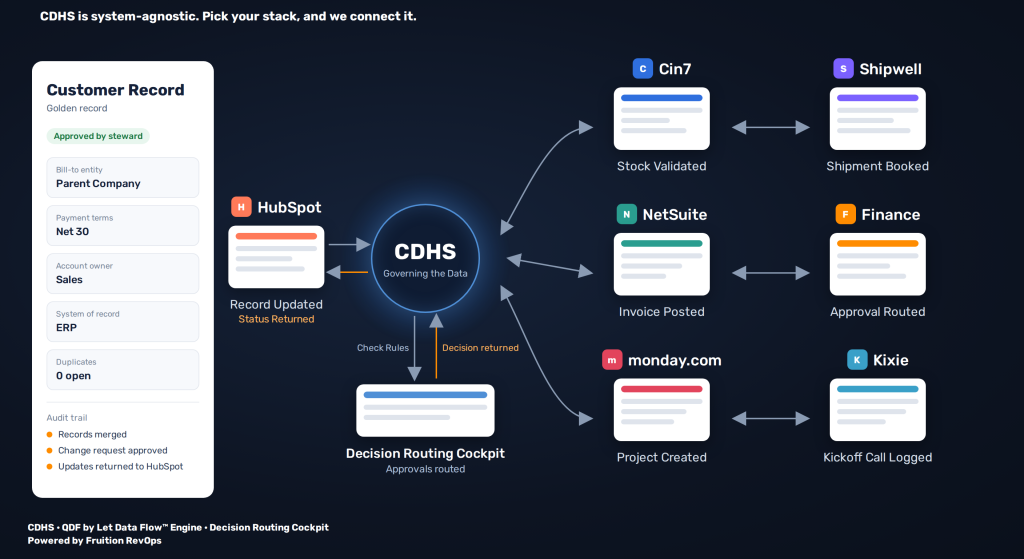
The Centralized Data Hub System (CDHS) from Fruition works on those decisions. CDHS sits between your existing systems and acts as a translator. HubSpot, your ERP, and your finance tools then follow the same business rules without another round of point-to-point integrations.

Each decision gets a rule. When a customer’s bill-to entity changes, open quotes reassign to the parent and invoices over a set amount go to finance for review. When a duplicate appears, for example, the record from your system of record wins. Rules for the calls that need a person are set in the Decision Routing Cockpit. It sends each one to the right owner with the context attached. A person still makes the judgment calls, and the system handles the repeat work. When a process changes, you update one rule instead of chasing it through five integrations.

CDHS works with or without an MDM product. If you already own one, CDHS carries its golden record into daily operations. If you don’t, CDHS keeps records consistent across the systems you already run.
A water infrastructure company running HubSpot and Zoho saw the difference after putting CDHS in place.
Many companies start smaller, with one Quick Data Flow (QDF) that fixes a single high-friction handoff. They grow into CDHS as the rules multiply.

How to Choose Among Master Data Management Platforms

The right vendor depends on where your data problem lives. Work through these points before you shortlist anyone.
1. Name the domain that hurts most. Customer data, product data, and supplier data each point toward different vendors.
2. Match your system of record. SAP shops lean toward SAP MDG, Azure shops toward Profisee, and broad multi-cloud estates toward Informatica or Reltio.
3. Count your stewards. Governance needs people to review exceptions. If nobody owns that work today, plan for it before you sign.
4. List the decisions as well as the records. Write down every place a record change triggers work in another system. Our SAE Map is one way to chart those flows.
5. Size the cost of doing nothing. Duplicate entry and manual approvals cost real hours. The Data Leakage Calculator puts a number on that cost.
If step four turns up more problems than step one, your bigger risk may sit in the decisions around the record. That finding changes which vendor you need, and it may change whether you need one at all.

Frequently Asked Questions

What Is a Master Data Management Platform?
A master data management platform keeps one trusted version of shared business data, such as customers, products, and suppliers. It shares that version with every system that needs it.Think of a family where Mom keeps one calendar on her phone, Dad keeps another on the fridge, and the kids keep a third in their heads. A master data management platform is the person who collects every version, fixes the conflicts, and hands everyone the same corrected calendar.
Survivorship is the set of rules that decides which value wins when two records describe the same thing. A common rule says the ERP wins on billing address and the customer relationship management (CRM) system wins on contact details.

Data governance is the rulebook for all of a company’s data. It decides who owns each kind of data, who can create or change it, how it must be formatted, who can see sensitive fields, and how long it is kept. It covers everything from customer records to financial reports to employee files.

MDM is one way a company follows that rulebook, focused only on master data such as customers, products, and suppliers. It finds duplicates, decides which version is correct, and shares that golden record with every system.

In the family calendar, governance is the house rules, such as only Mom adds doctor appointments and every sleepover needs a parent’s OK. MDM is the person who keeps the calendar correct by following those rules. You need both, because a calendar with no rules fills up with conflicts, and rules with nobody keeping the calendar never get followed.

CDHS can work alongside an MDM platform. The MDM product keeps the golden record correct, and CDHS acts as a translator between your systems so that record drives the right work in HubSpot, your ERP, and your finance tools. When a decision needs a person, such as approving new payment terms, CDHS sends it to the Decision Routing Cockpit, where the rules are set, and the decision comes back to CDHS. Updates then flow back to HubSpot, so sales sees the same answer as finance. 

In the family calendar, MDM keeps the calendar correct. CDHS makes sure everyone acts on it, so the carpool gets booked, the sleepover gets a parent’s OK, and the whole family hears back when plans change.

Find Out Where Your Data Stops Following the Rules

Your master data might be clean already. The question is what happens to it between systems. Talk with us about the decisions that still run through inboxes. No strings attached.

Schedule a Time with our Expert!

— Fill out the Form and let's meet —

Fill out the form below to book your meeting to get your HubSpot Audit Report.

Schedule a meeting
Your HubSpot Onboarding Plan.

** Schedule to have you High level plan for free.

Funnel Types List

Register and Get the Funnel List type

Provide you with a complete overview of the type of funnel and how to manage it. 

JOIN OUR LIVE EVENT!

Wednesday, October 18th
10AM (PST)

Webinar Topic: Fix the Leak with Streamline Your Revenue Path with RevOps Funnels. 
How to seamlessly guide prospects through your company’s journey,

  1. Utilize the Funnels in Revenue Operations
  2. How to Prevent Bleeding Prospects and Customers in Your Company’s Journey
  3. How to Automate the Process for Enhanced Efficiency

RevOps Knowledge Sharing!

Fill out the form below, and blogs, videos and content will come directly to your inbox.