You Sell the Strategy. Something Still Has to Decide Which Number Is Right.
Your agency sells strategy, and everything you deliver runs on the client’s data. When their tools disagree about the same numbers, your strategy starts acting on the wrong version, and from the outside it looks like your work failing. Fruition RevOps builds the layer that decides which system is right, the one the whole Unbound 2026 agenda quietly depends on.
It Starts as a Typo and Ends as a Forecast
The first sign usually looks like your strategy underperforming.
A nurture campaign fires on a list that still includes accounts that closed last quarter. A lead score puts a churned customer at the top of the rep’s queue. The client pulls a pipeline number that doesn’t match the one in the deck you sent Monday.
Each one looks like a miss in the work. Underneath, it’s the same thing every time. The systems feeding your strategy don’t agree on the basic facts of the account, and nothing in the stack is deciding which version is right.
And It's Your Hours That Pay for It
When the systems disagree, someone has to reconcile them, and that someone is usually you.
It’s the analyst on your side checking the client’s pipeline number against the CRM before the QBR. It’s the extra pass before a campaign goes out, making sure the list isn’t full of closed accounts. It’s the apology when the client catches something first. None of that work is billable, and all of it comes out of your margin.
The client experiences it as doubt about your strategy. You experience it as hours you can’t bill and credibility you can’t get back. The disagreement in the data quietly becomes a problem with your account.
Connected Isn't the Same as Agreed
The client’s tools are already connected. HubSpot passes records to the billing system, the billing system feeds an ops board, and somewhere a rep keeps a spreadsheet the CRM never sees.
Connection moves data between those systems. It doesn’t decide which one is right.
One Client Account. Three Systems. No Agreement.
So when three tools hold the same account and each believes its own version is current, the disagreement just sits there. The freshest-looking record wins by accident instead of by rule, and your strategy acts on whatever it’s handed.
The core message of HubSpot Unbound 2026 is that growth is being rebuilt around AI, and the winners are the ones whose AI can be trusted and held to a number. HubSpot is moving to an AI-first go-to-market, an agentic customer platform where AI agents work across the whole customer journey and Breeze runs through all of it.
Every session on the agenda, from “Build an AI-Driven GTM Engine” to “The 5-Layer Marketing System,” rests on the same assumption. The layers underneath are handing up clean, agreed records. The moment they aren’t, every agent and every layer above inherits the disagreement, and the sharpest AI in the room runs on the wrong facts. Underneath all of it, the missing piece is a decision layer, the thing that settles which system is right before any agent or any strategy acts on the data.
So, What's a Decision Layer?
A decision layer is a simple idea with an unglamorous job. It sits above all the connected systems and settles arguments.
None of those tools was ever told which one is in charge of what. So when they disagree, there’s no answer.
A decision layer is the rule that puts one system in charge of each field. Billing owns the contract value. HubSpot owns the lifecycle stage. The ops board owns fulfillment status. Once every field has a clear owner, a disagreement stops being a mystery. The layer already knows which system wins, and it corrects the others automatically.
For example
Picture one client account. In HubSpot it reads as a customer worth $40,000 a year. In QuickBooks, the same account renewed in March at $60,000. And on the monday.com ops board, it still shows the $45,000 from when the project kicked off.
None of the three is wrong. Each is reporting what it was told. So when a campaign, a forecast, and a QBR each reach for “the number,” they get three different ones, depending on which system they happened to read.
A decision layer settles it once. QuickBooks owns contract value, so $60,000 becomes the number everywhere, and the other two fall in line.
Think of the decision layer as an org chart for the data. Data governance is the technical term. It’s a set of rules about who’s right, enforced everywhere at once. The client doesn’t get another tool to log into. They get one answer instead of three.
At Fruition RevOps, building that decision layer is what we do, for your agency and the clients you deliver to. When the data decides by rule, every strategy you build on top of it finally runs on data it can trust.
First, See Exactly What You're Dealing With
You can’t decide who’s right until you can see who’s holding what. So the work starts with a map.
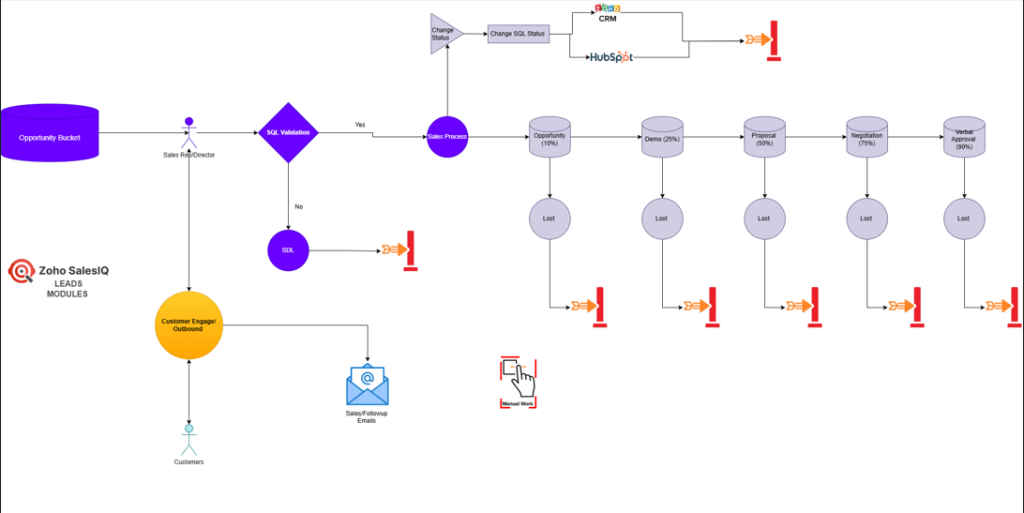
Fruition RevOps calls this a Systems Automation Engagement (SAE) Map Map, a single picture of the client’s systems and the customer journey running through them. It shows every place the same record lives, every handoff between tools, and every point where two systems can drift apart.
That map is the diagnosis. It tells you which handoff is bleeding, which fields are in conflict, and where a decision layer earns its keep first. Nothing gets built until the picture is clear.
Start Small: One Workflow, Decided
To put a decision layer to work, you start small. You take the worst handoff on the map and make it the first thing that runs by rule.
That first build has a name. Fruition RevOps calls it QDF, Quick Data Flow. A QDF takes one workflow, the marketing-to-sales pass, or the closed deal that should reach onboarding and stalls, and puts a rule on it. Which system owns the record, what has to be true before it moves, and where it goes next. From then on, that one handoff decides itself the same way every time, instead of waiting on someone to check it by hand.
It’s scoped to a single process on purpose. That keeps it small enough to prove the idea quickly and bill for it on its own, before the client commits to anything larger. And because it runs on the client’s real records, it surfaces exactly where the rest of the data disagrees. That’s the next section of the map, drawn for you.
A Client We Built This For
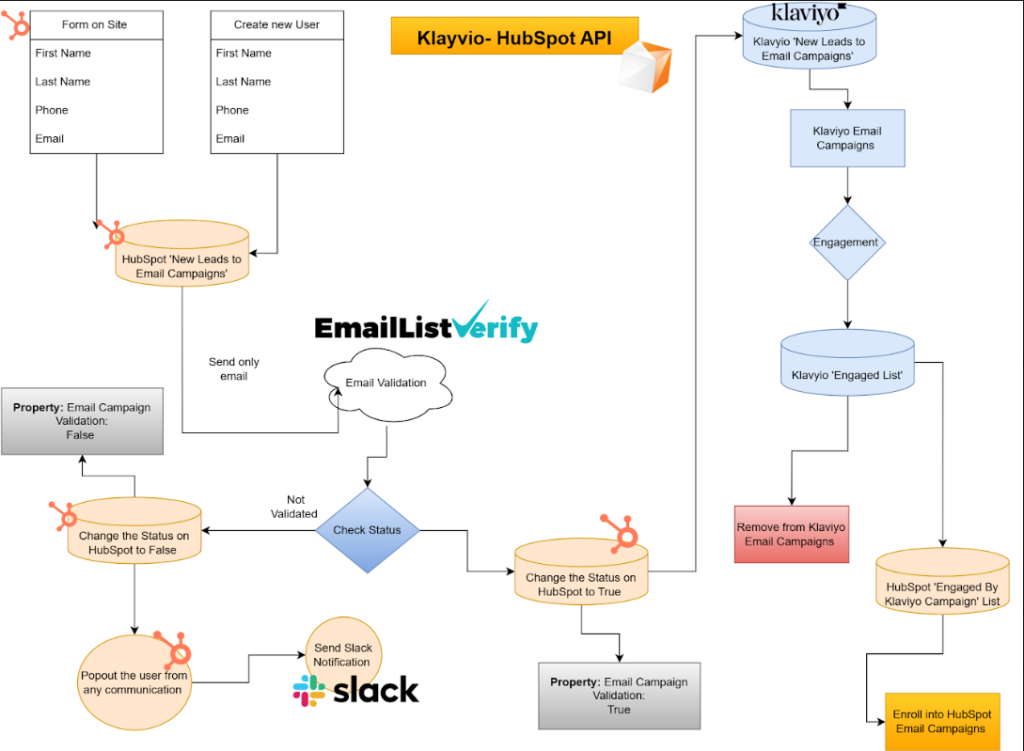
Here’s one decision layer we shipped, running on a client’s real data. Every week, leads poured into HubSpot from webinars, inbound forms, exhibitions, referrals, and the website. Each source dropped them in a little differently, and nothing agreed on who should pick each one up. So a person sat in the middle of it, reading every lead and deciding where it went. That was 6 to 7 hours a week, gone.
The layer we built does that reading itself. The moment a lead lands, it applies the routing rules the client set, resolves which source and owner win, and hands the lead to the right rep in seconds. No queue, no daily triage, no hot lead going cold while it waits for a human to place it. Those hours go back to the team.

Scale Up: The Full Layer, CDHS
Once the client watches one handoff run clean, the case for the full layer makes itself.

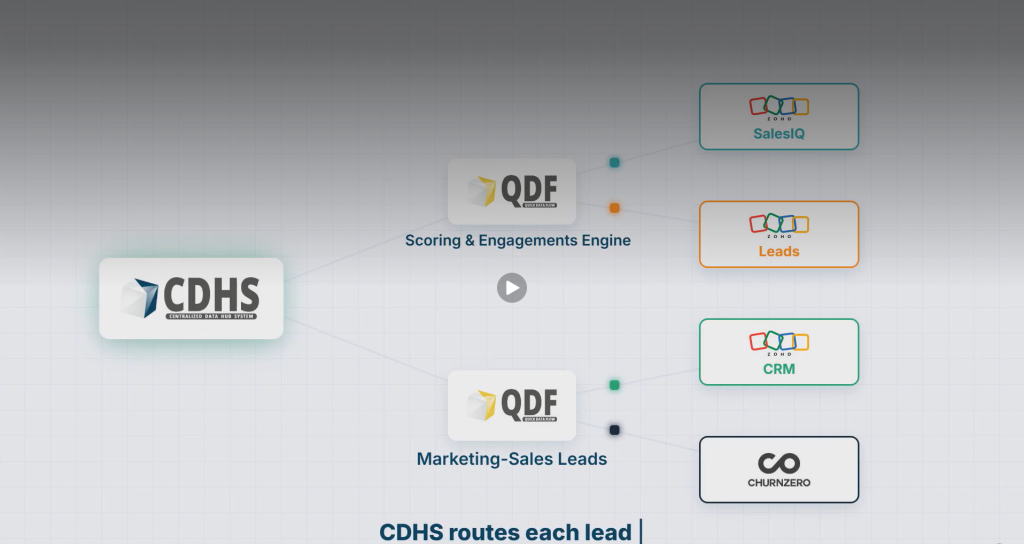
Fruition RevOps builds that full layer too. It’s called CDHS, the Centralized Data Hub System, and it’s the decision layer applied across the whole stack instead of one workflow. Fruition RevOps builds it to hold the client’s ownership rules in one place and enforce them across HubSpot, billing, and operations, so every layer you deliver on top inherits records that already agree.
It has been built at scale. One Fruition RevOps client, a $100M+ manufacturer, runs a single source of truth across CRM, ERP, production, and finance on this exact layer. That’s the same pattern an agency can deliver inside a client account, at whatever size the account is.
Three Moves, in Order
The path is always the same. See it, prove it on one workflow, then scale it into the foundation.
Step 2
Start Small
A QDF puts one workflow under a rule, so it decides itself and bills on its own.
Step 3
Scale Up
CDHS extends the rules across the whole stack, so every layer works from the same trusted record.
The Decision Layer, Already Running
None of this is hypothetical. Fruition RevOps has already built decided handoffs like these inside HubSpot stacks, and each one started exactly where yours would, with a single workflow that used to wait on a human.
Deal closes, production starts
The moment a deal closes and payment clears, sales orders generate and production starts on their own. The handoff decides itself.
Requests route themselves
Submitted requests route straight into tickets and billing, with no one copying fields between systems by hand.
Projects start on their own
A client’s ops team used to sit idle waiting for a handoff after every closed deal. Now the projects start themselves.
What This Means for Your Agency
For an agency, the decision layer sits in a useful place. It’s infrastructure, so it lives underneath the strategy work you’re known for instead of competing with it. You design and deliver the system, under your own brand and inside your own client relationship.
The layer that keeps the data honest runs quietly beneath it.
It also changes the shape of the engagement. Strategy work tends to end when the plan is approved. A decision layer keeps running as long as the client does, so the value you deliver stays visible long after kickoff, and the relationship has a reason to keep going.
Bring the Account Costing You the Most
When you’re at HubSpot Unbound 2026, bring the client account that costs you the most. The one with the handoff that keeps breaking, or the report you check twice before you send it.
We’ll map it live in 20 minutes and show you where the data is deciding by accident. You leave with the blueprint, whether or not you ever hire us.
Schedule a Time with our Expert!
— Fill out the Form and let's meet —
Funnel Types List
Register and Get the Funnel List type
Provide you with a complete overview of the type of funnel and how to manage it.
JOIN OUR LIVE EVENT!
Wednesday, October 18th
10AM (PST)
Webinar Topic: Fix the Leak with Streamline Your Revenue Path with RevOps Funnels.
How to seamlessly guide prospects through your company’s journey,
- Utilize the Funnels in Revenue Operations
- How to Prevent Bleeding Prospects and Customers in Your Company’s Journey
- How to Automate the Process for Enhanced Efficiency
RevOps Knowledge Sharing!
Fill out the form below, and blogs, videos and content will come directly to your inbox.