
What a CRM Needs Before It Can Drive Action

The Fruition RevOps team went through the UNBOUND 26 agenda and found The Decision Engine session by BabelQuest. It’s a great session we just had to share with you. Read this first, though, because an engine is only as good as the number it fires on, and that part is on you, not the stage.

The Decision Engine: How to Build a CRM That Drives Action

When

Wed, Sep 16 · 11:00am to 12:30pm ET

Where

Room 157, Boston

Hannah Fisher and Chris Grant, Principal Consultants at BabelQuest

A lead arrives, a stage moves, a task gets logged, a report gets run.

All of it is a careful record of what already happened. The work of deciding what to do about it still sits with people, in a meeting, on a Thursday, looking at a dashboard and working out what it means. That gap is what the Decision Engine session at UNBOUND 2026 is built to close. Hannah Fisher and Chris Grant from BabelQuest run it Wednesday morning in Room 157, and their D3 Framework, Discover, Decode, Decide, is a way to move HubSpot from a system that records your work to one that helps you act on it.

It fits the theme of the whole event. This is the year HubSpot stops just holding your work and starts acting on it. Agents across the customer journey, workflows that fire on their own, a CRM built to decide and move. So this is worth understanding well before you walk into the room, because a CRM that drives action is a different machine from the one most people are running, and it asks for different things.

Why Most CRMs Manage Process Instead of Guiding Decisions

A CRM is very good at capturing state. It knows the deal is in stage 3, the contact opened the email, the ticket is still open. What it doesn’t do on its own is answer the question a leader is actually holding. Which of these deals is real. Where is the forecast soft. What should we do this week that we aren’t doing.
Those are decision questions, and the jump from recorded state to decision has always been manual. Someone exports the data, someone builds the view, someone reads it aloud in a meeting. The CRM managed the process. The people made the calls, slowly, and often from different copies of the numbers.

A decision engine is the attempt to close that jump inside the system itself. Instead of a person reading a dashboard and deciding, the CRM scores, forecasts, routes, and acts, using rules and, increasingly, AI agents. That’s the shift the D3 Framework is teaching, and it’s the shift the entire UNBOUND agenda is built around.

What Discover, Decode, Decide Asks of Your Data

Walk the three steps and you can see what each one quietly depends on.

Step 1

Discover

Connect the data to a strategic question, across every system that holds part of the answer.

Step 2

Decode

Read the meaning out of it, forecast the outcome, spot the account about to slip.

Step 3

Decide

Turn it into action. A workflow fires, an agent reaches out, a task lands on the right rep.
Discover only works if the data behind the question is actually present and actually correct. The CRM knows the deal stage. Your finance system knows what was invoiced. Your delivery tool knows what shipped. Discover is asking all three to line up.
Decode is only as honest as its inputs. Feed it a pipeline figure that finance would dispute, and it decodes a story that isn’t true, with a confident chart on top.
Decide is where a wrong input does the most damage. It isn’t a person hesitating over a number anymore. It’s the system committing to it.

What Changes When a CRM Decides

The difference between the CRM most people run and the one the UNBOUND session describes comes down to who makes the call, and how fast.

The CRM you run today

Records What Happened

Logs the stage, the email, the open ticket
Waits for a person to read it and interpret it
Acts only once someone decides and hits go
A wrong number just sits in a report until someone notices

The CRM Unbound Describes

Drives the Next Action

Scores and forecasts on its own

Routes, flags, and reaches out in seconds

Acts without waiting for anyone to approve it

Commits to whatever number it reads

Every advantage on the right depends on the last line. Speed is a gift when the record is right and a liability when it isn’t. The recording CRM had a person in the loop who could catch a bad figure before it went anywhere. The deciding CRM takes that person out, on purpose, so the thing it reads has to be correct before it reads it.

What the Disagreement Already Costs

This isn’t only a problem waiting for AI to make it worse. Systems that hold different numbers for the same account already carry a price, and it has been measured.

$12.9M

Average yearly cost of poor data quality to an organization

47%

Of organizations believe they have high-quality data to work from

45%

Of sales leaders and sellers are confident in their own forecast
Gartner puts the average cost of poor data quality at a minimum of $12.9 million a year for the organizations it studied. Some of that is time, ops rebuilding the real figure by hand before a meeting. Some of it is decisions made on the wrong version and paid for later.
It shows up most in the number leaders lean on hardest. In Gartner’s State of Sales Operations survey, fewer than half of respondents, 47%, believed their organization had high-quality data, and only 45% of sales leaders and sellers had high confidence in their own forecast. When the forecast can’t be trusted, people fall back on instinct, the exact habit a decision engine is meant to retire.

A decision engine is only as good as the number it fires on.
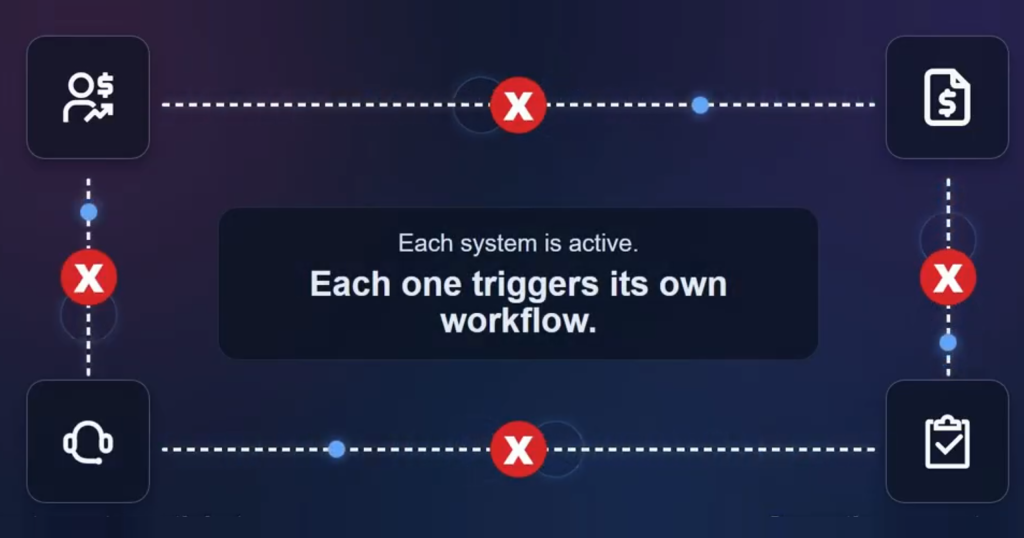
A person catches a figure that looks wrong and goes to check. A decision engine reads the value it was pointed at and acts. So the question is no longer how smart the engine is. It’s whether your systems agree on what they’re feeding it.

The Stakes Go Up When the CRM Acts on Its Own

The reason this matters more this year than last is the thing HubSpot and the rest of the agenda are rolling out. Agents that act without waiting for a person to approve the move.
The early results are sobering. Gartner expects more than 40% of agentic AI projects to be canceled by the end of 2027, pointing to escalating costs, unclear business value, and weak controls. Most are still experiments that haven’t shown a return.
Data agreement is where a lot of that value quietly leaks. An agent that acts on a figure two of your systems dispute produces the exact outcome that gets a project shelved. It does the wrong thing at machine speed, and someone spends the next week unwinding it. The agents that earn their place are the ones pointed at data the business already agrees on. The ones that don’t are where the escalating cost comes from.

So the real question the session is putting to you is whether the data underneath your agents is settled enough to trust what they do next.

Give the Engine One Number to Trust

Give the engine one source of truth.

Most stacks can’t do that yet, and the reason is quieter than it sounds. Your systems are already connected. Connected and agreed are not the same thing. HubSpot, your finance system, and the spreadsheet a rep keeps can each hold a different value for the same account, all of them current, none of them wrong inside its own tool. Connection moves that data around. It never decides which version is right.

So before a CRM can safely drive action, one rule has to be settled underneath it. Each number gets a single system that owns it. Finance owns the contract value. HubSpot owns the deal stage. Delivery owns fulfillment status. Once ownership is clear, a disagreement stops being a standoff, and the engine always has one answer to act on instead of three to guess between. Deciding who owns each number and enforcing it everywhere at once is a discipline with a name. Data governance. The agreed layer it produces is called a decision layer, and building it is the work we do at Fruition RevOps.
See You in Boston

Room 157 is a good use of your Wednesday morning. The D3 Framework is a genuinely useful way to think about turning HubSpot from a system of record into a system that decides, and BabelQuest knows the platform. Bring one question with you: Before your CRM decides anything, do your systems agree on the number it’s deciding from? If they do, everything the session teaches compounds. If they don’t, the first thing to build isn’t a smarter workflow. It’s the layer that settles which number is real.

Meet us at UNBOUND 2026. We’ll talk through where systems usually stop agreeing on the same number, and how other teams have gotten everyone working from one version before the engine acts on it.

© All Rights Reserved (C) Fruition Inc.
San Diego, CA. 92127

Schedule a Time with our Expert!

— Fill out the Form and let's meet —

Fill out the form below to book your meeting to get your HubSpot Audit Report.

Schedule a meeting
Your HubSpot Onboarding Plan.

** Schedule to have you High level plan for free.

Funnel Types List

Register and Get the Funnel List type

Provide you with a complete overview of the type of funnel and how to manage it. 

JOIN OUR LIVE EVENT!

Wednesday, October 18th
10AM (PST)

Webinar Topic: Fix the Leak with Streamline Your Revenue Path with RevOps Funnels. 
How to seamlessly guide prospects through your company’s journey,

  1. Utilize the Funnels in Revenue Operations
  2. How to Prevent Bleeding Prospects and Customers in Your Company’s Journey
  3. How to Automate the Process for Enhanced Efficiency

RevOps Knowledge Sharing!

Fill out the form below, and blogs, videos and content will come directly to your inbox.