


















Blueprint your revenue system like an architect blueprints a house.
See every platform, process, and handoff mapped visually.

The Systems Automation Engagements (SAE) Map reveals how your business actually operates. Most companies can’t answer: “Where does data break between Marketing and Sales?” or “Why do Operations build the wrong thing?” SAE shows you the answer — every system, every workflow, every gap highlighted in one visual map.

System Automation Engagements (SAE)

Visualize how your systems truly connect, revealing where data flows, stalls, or gets lost between teams.

Stop losing deals in the handoff between Sales, Ops, and CS. QDF moves data and triggers actions between systems instantly.

Your sales team closes a deal. Finance doesn’t see it for 3 days. Operations builds the wrong thing. Customer Success never gets the handoff. Quick Data Flow (QDF) fixes this — data flows between systems in real-time, without custom code that breaks when platforms update.

Workflow Automation

Turn every manual process into motion — connect systems, trigger actions, and let automation carry your revenue forward.

When every system tells a different story, nobody can make confident decisions. CDHS unifies CRM, ERP, Finance, and Ops into one real-time data layer and Single Source of Truth.

Your CRM says one thing. ERP says another. Finance is running reports from spreadsheets. Nobody trusts the data. The Centralized Data Hub System (CDHS) is your Single Source of Truth (SSOT) — real-time sync across every platform, governed data, and one unified view that actually works.

CDHS: How it Works?

Bring your data together in one place. It’s built to sync in real-time, link, and deliver insights you can use tomorrow.

Pre-built campaign automation kits, deploy customer engagement workflows without custom development.

Automation Campaigns Creator (ACC) provides pre-built engagement workflow kits designed to address specific areas of revenue leakage. Each ACC KIT includes campaign architecture, automation sequences, and multi-channel touchpoints — ready to deploy without custom development.

Automation Campaigns Creator (ACC)

Transform your Customer Engagement Journey with ACCs’ KITs intuitive automation tools.

Capture Decisions, Assign Tasks, and Keep Work Moving Without Manual Follow-Ups

Teams leave meetings with good intentions, but follow-through breaks down. Notes scatter across Slack. Action items disappear into documents. TALK-to-TASKS closes the execution gap — turn meeting recordings into correctly routed tasks automatically.

How TALK-to-TASKS Works?

Routing conversations from meetings with two clicks into the right place to the right person on your Project Tool.

Connecting systems is a solved problem. Governing the decisions inside them is not. The Decision Routing Cockpit is where the rules that run your revenue business finally live in one governed layer.

Right now those rules live in four places at once. A workflow no one owns, a spreadsheet no one updates, a script only one contractor reads, and the head of the person who remembers. The Decision Routing Cockpit (DRC) pulls all of them into one governed layer, with global defaults, per-case overrides, and every change audited six ways.

How Does It Work?

Every rule your revenue business runs on becomes named, scoped, and auditable. By the business, without a developer touching code.

Data Flow Architecture Design

Built from your SAE Map, we design workflows that connect systems and trigger the right actions at the right time.

Integration Path Selection

We choose the optimal path—native connectors, APIs, iPaaS (Make, Workato), or N8N—for reliable, scalable data flow.

Team Training & Documentation

We onboard your team, document workflows, and ensure everyone knows how the system works.

We design and build QDFs that move data and trigger actions across your systems in real-time.

You need workflows that don’t break when platforms update. We implement Quick Data Flows using your SAE Map as the blueprint—connecting CRM, ERP, operations, and finance so every action flows automatically without custom code that breaks on the next update.

CDHS Architecture Design

Built from your SAE Map, we design the central hub that connects all systems and establishes your single source of truth.

Master Data Management (MDM)

We establish control and accuracy across every record, ensuring clean, consistent, reliable data everywhere.

Data Governance & Flow Rules

We define ownership, validation rules, and automated flow logic to keep your data clean as it scales.

We implement CDHS so every system, report, and decision runs from one source of truth.

When CRM, ERP, Finance, and Operations all tell different stories, nobody can make confident decisions. We build your Centralized Data Hub System using your SAE Map to define data ownership, flow rules, and governance—so you finally have one real-time view that everyone trusts.

Campaign Strategy & Journey Mapping

We map your customer journey, identify engagement gaps, and design campaigns that address specific revenue leakage points.

Multi-Channel Workflow Design

We design coordinated workflows across email, SMS, in-app messaging, and sales triggers for unified engagement.

Campaign Launch & Optimization

We build, test, launch, and continuously optimize your campaigns for maximum conversion and engagement.

We design and deploy multi-channel engagement campaigns using ACC templates—customized for your customer journey.

Generic email sequences don’t work. We build Automation Campaign Creator (ACC) workflows tailored to your specific revenue leakage points—combining email, SMS, in-app, and sales triggers across HubSpot, Klaviyo, and your CRM to drive engagement that converts.

Integration Architecture & Path Design

Selecting the optimal path for seamless, scalable data flow across Departments.

Custom Implementation & Config

From simple plug-ins to advanced cross-system builds, we tailor each setup to your business logic.

Mastering Seamless Migration & Implementation Systems

Your new tools integrate smoothly, align with your workflows, and start delivering value from day one.

We don't just connect systems, we make them work in harmony. Fruition designs, builds, and implements integrations that keep your operations flowing without friction.

Most integrations are duct-taped APIs that break when platforms update. We design integration architecture for the long term—selecting the optimal path through native connectors, APIs, N8N, or iPaaS like Make or Workato.

15-minute conversation that reveals where your revenue system breaks — gaps, silos, missed handoffs mapped visually.

Most companies can’t answer basic questions: “Where does our sales data break?” “Why doesn’t Operations know what Marketing promised?” The SAE Diagnostic reveals your answer in 15 minutes — a visual map showing exactly where systems disconnect, data gets lost, and revenue leaks.

System Automation Engagements (SAE)

Visualize your business blueprint. See every system, process, and touchpoint in one place.

Stop Revenue Leakage

Find and fix the invisible cracks draining your time, money, and margins — before they turn into growth barriers.

Preventing your Data Silos — Get your SSOT

Centralize scattered data and replace confusion with clarity, ensuring every department works from one truth of data and build your single source of truth (SSOT).

Process Mapping & Documentation

We map how work truly gets done across RevOps, Production, and Operations — turning chaos into structured processes.

SOP Design for Automation Readiness

Every SOP is built with automation in mind, ensuring systems and people work together. Not against each other.

Adoption & Change Enablement

We don't just document; we drive adoption. Teams learn how to follow, improve, and trust the process, turning SOPs into muscle memory.

Transform tribal knowledge into repeatable workflows, giving your teams the structure to scale with clarity and consistency.

Automation breaks and centralization stalls when teams work from memory instead of process. We map how work truly gets done — turning SOPs into muscle memory, not shelfware.

Team Training & Enablement

Hands-on training sessions tailored to your team's roles, ensuring everyone uses new systems confidently from day one.

Adoption Measurement & Optimization

Track adoption metrics, identify blockers, and continuously optimize workflows to ensure your team actually uses what you built.

Gold Partner Implementation Support

We're Gold Partners with HubSpot, Monday.com, and Segment — meaning we bring certified expertise to every implementation.

We don't just hand over systems — we onboard your team, train them to use tools confidently, and ensure adoption sticks.

New systems fail when teams don’t adopt them. We train, enable, and support your team through the transition. As Gold Partners with HubSpot, Monday.com, and Segment, we know how to make systems work for your people.

RevOps Strategy & System Architecture

We align your go-to-market strategy with your tech stack, designing the operational backbone that connects Marketing, Sales, and CS.

Performance & Optimization with Automation Support by AI agent

Our consultants analyze your funnel, uncover hidden inefficiencies, and rebuild your operations for precision, speed, and scalability.

Tech Stack Alignment & Implementation

From HubSpot and NetSuite to Monday.com and Shipwell, we integrate and orchestrate your tech ecosystem into one coordinated revenue engine.

Strategic advisory for revenue operations — system architecture, automation strategy, data governance, and team enablement.

RevOps isn’t just about connecting systems — it’s about aligning strategy, data, and execution. Our consultants bring two decades of experience building revenue engines for $50M-$500M companies.

The LET DATA FLOW™ Framework

Fruition RevOps’ proven framework turns disconnected systems into synchronized revenue engines. Each stage reveals where your data, workflows, and teams fall out of sync, and rebuilds them into one intelligent flow that drives efficiency, visibility, and growth.
Four stages that guarantee smooth process alignment

1

Diagram Your SAE Map

Map how your business actually operates across teams, capturing the customer journey, decision points, system roles, data handoffs, and revenue flow. This blueprint surfaces inefficiencies and defines what must be automated versus redesigned.

2

Map Your Data & Automation Attributes

Translate the SAE blueprint into a concrete data flow and automation model — defining system ownership, data attributes, relationships, and trigger logic. This prepares your foundation before building QDFs.

3

Centralize the Flow (CDHS)

Implement the Centralized Data Hub System as the governance layer connecting all systems and QDFs. CDHS enforces data ownership, flow rules, and establishes a single source of truth — ensuring automation stays stable as you scale.

4

Build & Execute Data Flow (QDF)

Deploy targeted Quick Data Flows that move data and trigger actions across systems in real time. Each QDF handles a specific business event — deal progression, order creation, production updates, billing changes — without manual intervention.

Manufacturing

Sync production schedules, inventory, and order fulfillment across ERP, CRM, and operations.

Healthcare

Connect patient data, billing, and care coordination across EMR, RCM, and operations systems.

Technology

Align product, engineering, sales, and customer success with real-time data across tools.

Consumer Services

Unify ticketing, CRM, and knowledge bases to deliver seamless customer experiences at scale.

Retail

Connect POS, inventory, e-commerce, and fulfillment for real-time visibility across channels.

Franchisors

Centralize franchise operations, royalty tracking, and performance reporting across locations.

Agencies

Sync project management, client billing, and team capacity across tools for better margins.

Investments

Unify portfolio tracking, deal flow, and LP reporting for complete investment oversight.

Meet Our Team

The automation architects, data specialists, and RevOps consultants behind Fruition.

Our History

Two decades transforming disconnected systems into unified revenue engines.

Partner With Fruition

Join our network of agencies and consultants implementing Fruition frameworks.

Our Philosophy

Where technology meets process—aligning Platforms, People, Processes, and Insights.

Resources & Learning

Latest Blog Posts

Stay current with RevOps insights and automation strategies

VideoTube Channel

Watch automation tutorials and implementation guides

Free RevOps Evaluation

Assess your revenue operations maturity

ACC Templates

Pre-built automation campaign kits ready to deploy

Framework Guide

Learn the Let Data Flow methodology step-by-step

Contact Our Team

Talk to automation architects about your systems

Case Studies

Real implementations with measurable results

Tools & Calculators

Revenue Leakage Calculator and diagnostic tools

Start Here Page

Not sure where to begin? We’ll guide you.

Why Data Flow

Most RevOps fixes treat the symptom. This is how we fix the operating model underneath.

Data Leakage Calculator

Find out how much revenue your business is losing and exactly where it’s slipping through the cracks.

Pricing

Every engagement follows a logical journey. Here’s where it starts.

SAE Architecture Map

Find where your revenue is breaking — every engagement starts here. We map your systems, identify leakage points, and show you exactly what to fix first.

Which Revenue Operations Providers Keep Marketing Automation and Your CRM in Sync?

Revenue operations providers usually get the call after a meeting where marketing reports 400 new leads and sales says it saw 90. Both numbers are correct in their own system. The marketing automation tool counted every form fill. The CRM only counted the records that made it across, matched an owner, and survived the duplicate check.
Closing that gap is a different job from choosing the right marketing platform in the first place. It depends on how the two systems hand records back and forth, and on who decides the rules for each field. The right provider makes those decisions with you and writes them down, so the next person who changes a form doesn’t undo them.
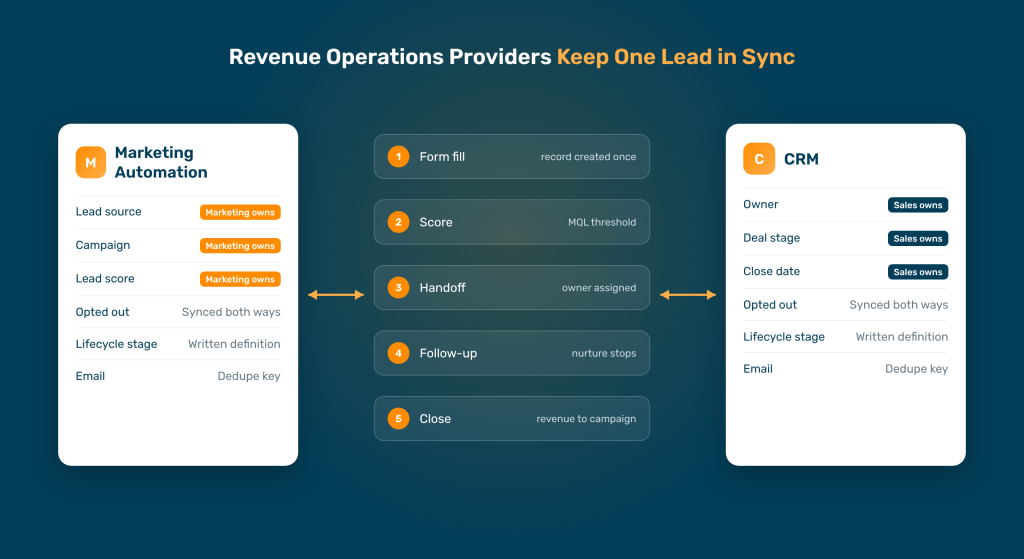
Revenue operations providers keeping one lead in sync between marketing automation and the CRM, with field ownership and five handoff steps

What It Means for Marketing Automation and a CRM to Stay in Sync

Most marketing automation tools and CRMs share five kinds of records. Those are people (leads and contacts), companies, deals, activities like emails and meetings, and campaigns. Staying in sync means each of those records looks the same in both systems, or at least close enough that nobody has to check.
The hard part is deciding which system wins when two values disagree. HubSpot’s own planning guide for its Salesforce connector asks you to set a sync rule for every mapped field. The options include always using Salesforce, always using HubSpot, using one unless the field is blank, or letting the most recent update win.
Those choices sound small, yet each one decides whose version of the truth sticks. If both systems can overwrite a lifecycle stage, a contact can bounce between marketing qualified and sales qualified every time someone edits it. For that reason, a good provider spends more time on these rules than on the connector itself.

Where to Find Revenue Operations Providers

Revenue operations providers come in a few distinct shapes. Each one fits a different starting point, so it helps to know which kind you’re talking to before the first call. In practice, many companies end up using two of them, such as a vendor partner for the platform and a fractional lead to own the rules.

Marketing Automation Partner Directories

If most of your stack comes from one vendor, start with that vendor’s partner directory. HubSpot runs a Solutions Partner Program with five tiers as of July 2026. Those are Solutions Partner, Gold, Platinum, Diamond, and Elite, and each tier is based on the business a partner sources and manages.
Tiers mostly reflect volume. For skill with your particular setup, HubSpot also offers partner accreditations that speak more directly to technical work. These include Data Migration, CRM Implementation, Solutions Architecture Design, and Custom Integration. A partner with the Custom Integration accreditation has shown it can build with HubSpot’s developer tools, which matters once a native connector stops covering your needs.
Salesforce keeps a similar directory of consulting partners. In both cases, the directory shows who knows the vendor’s platform well. It says less about how a partner handles a second vendor’s tool on the other side of the sync.

Independent RevOps Consultancies

Independent firms work across vendors. They fit best when your marketing automation tool and your CRM come from different companies. They also suit companies whose finance and operations systems need the same customer data.
Their scope usually reaches past the sync itself into lifecycle stages, lead scoring, and reporting. Many of the same firms also offer pipeline-focused services on the sales side. As a result, it’s worth asking which piece of the work they want to lead with, since the answer shows where their strengths sit.

Automation Builders

Some providers focus on building the data flows themselves, using connector platforms or custom code. They’re a good fit when the strategy is already settled and you need someone to wire a specific handoff. Sending event leads into the CRM with the right owner is a typical example.
The risk shows up when nobody owns the rules behind the flows. A builder will move data exactly as instructed. If the instructions are wrong, the mistakes simply travel faster. Small, well-defined data flow projects suit this kind of provider best.

Fractional RevOps Leads

A fractional lead is one senior person who works with you part-time. This option fits smaller companies that need someone to own the rules and manage outside builders, but can’t justify a full-time hire yet. The trade-off is capacity. One person can design the system, but they’ll often need a builder or a partner for the hands-on work. Still, having a single owner on your side makes every other provider easier to manage, because someone can say yes or no to each change.

How Native Connectors Handle the Handoff

Most popular marketing automation tools ship with a built-in connector to the major CRMs. Knowing what those connectors do on their own helps you judge what a provider adds on top.
HubSpot’s Salesforce connector syncs contacts, companies, deals, tickets, and activities. It’s available on Professional and Enterprise subscriptions, and it lets you limit which records sync in each direction.
Marketo Engage runs a continuous sync with Salesforce. According to Adobe’s documentation, leads, contacts, and Salesforce campaigns sync in both directions, while most other objects flow from Salesforce into Marketo only. Each sync cycle pauses for five minutes before the next one starts.
Salesforce’s own marketing tool, Marketing Cloud Account Engagement, lets you choose a sync behavior for each prospect field. Either system can win, or the most recent update can win. Regardless of the setting, a field with a value overrides an empty one.
So the plumbing usually exists already. What a provider brings is judgment about which settings to choose. They also handle the cleanup needed before the first sync copies years of duplicates into a second system.

Walk One Lead Through a Provider's Plan

The fastest way to compare revenue operations providers is to hand each one a single lead and ask them to walk it through your systems out loud. A strong answer covers each of these moments in order.
  1. The form fill. Which system creates the record first, and how does it check for an existing person with the same email?
  2. The score. Where does lead scoring live, and what exact threshold turns a lead into a marketing qualified lead (MQL)?
  3. The handoff. Which rule assigns an owner, and what happens if that rep is out? Routing logic often ends up split across forms, workflows, and the CRM. Ask where the provider would keep the routing rules and how changes get tracked.
  4. The sales follow-up. When a rep logs a call or changes the deal stage, does marketing see it, and do nurture emails stop?
  5. The close. When the deal closes, does the revenue tie back to the campaign that produced the lead?
After that, listen for specifics. A provider who names the fields, the sync rules, and the exception cases has done this before. Meanwhile, one who stays at the level of “we’ll sync everything” probably plans to turn on the native connector and stop there.

Red Flags in a Provider Proposal

Some warning signs show up on paper before any work starts, and they apply to revenue operations providers of every type.
First, watch for a proposal that skips testing. HubSpot itself recommends trying sync settings in a Salesforce sandbox or a HubSpot test account before touching production data. Any provider who plans to sync live records on day one is taking a risk with your database.
Second, be wary of a provider who wants to replace a tool your people already rely on. Sometimes a migration makes sense. Even so, it should come from a clear map of how your current systems hand data to each other. A System Automation Engagement (SAE) Map lays that out on one page before anyone recommends a change.
Third, look for documentation in the deliverables, since a sync nobody can explain is hard to fix later. If the sync rules live only in the provider’s head, they leave when the provider does.
Finally, check who owns the result after launch. Someone on your side should know which system wins for each important field and how to adjust it.

Opt-Outs and Consent Need Their Own Rules

Unsubscribes deserve separate attention, because a sync mistake here reaches the customer directly. If someone opts out in your marketing tool and a rep’s CRM still shows them as reachable, the next sequence can email a person who asked you to stop.
The major tools treat this field with extra care. Account Engagement, for instance, lets its own Opted Out value override Salesforce’s by default. Even so, the default only covers one direction of the problem. Opt-outs can also start in the CRM, in a support tool, or in a reply to a sales email.
Ask every provider how an opt-out travels from each system where it can start. A good answer names the field in each tool, the direction it flows, and what happens to a record that’s already enrolled in a sequence. In addition, ask how they’ll check the result after launch, since a single missed opt-out is easy to overlook in testing.

What a Finished Project Should Leave Behind

A sync project ends well when someone on your side can run it without the provider. That usually depends less on the build and more on what gets written down.
At a minimum, expect a field ownership sheet that lists each shared field, the system that owns it, and the sync rule. Next, expect written definitions for each lifecycle stage, so marketing and sales mean the same thing by a qualified lead. A short test log also helps, showing which records were checked before launch and what came back.
Finally, ask for a walkthrough with the person who will own the system day to day. Together, these pieces turn a one-time project into something your company can maintain. They also give every report a clear trail back to one source of truth, which is what the Monday meeting needed in the first place.

Revenue Operations Providers at a Glance

Provider typeBest fitWatch for
Vendor partner (HubSpot, Salesforce)Most of your stack comes from one vendorLess depth with tools outside that vendor
Independent RevOps consultancyMarketing and CRM tools from different vendorsScope that grows past what you need first
Automation builderRules are settled, and a handoff needs buildingNobody owning the rules behind the flows
Fractional RevOps leadSmaller companies that need an ownerLimited hands-on capacity

When the Default Sync Stops Fitting

At one business-to-business (B2B) company, marketing worked in HubSpot while sales lived in Zoho. The out-of-the-box sync between the two had drifted away from how the company sold, so each side counted leads its own way. Once both sides agreed on what counted as a lead, the systems stopped creating duplicates between them, and nobody had to switch tools.
That project started the way most good ones do. Before anyone changed a setting, someone mapped how records moved between marketing, sales, and the systems around them.

Frequently Asked Questions

Do I Need a RevOps Provider If My Marketing Automation and CRM Come From the Same Vendor?

Sometimes you can manage without one. A single-vendor stack removes most of the connector work, since the records already live in one database. You may still want help with lifecycle stages, scoring, and reporting, because those are design decisions the software doesn’t make for you.
Split ownership field by field. Marketing usually owns source, campaign, and score, while sales owns the owner field, deal stage, and close date. Writing that split down settles most arguments before they start.
Bring a list of your systems, a rough count of contacts in each, and the reports people argue about most. It also helps to know roughly what the current mismatch costs you. A quick estimate of time lost to bad data gives the conversation a starting number.

Get Marketing and Sales Counting the Same Leads

When your marketing automation tool and your CRM finally agree, the Monday meeting gets shorter. Fruition RevOps can help you trace where your lead counts split apart. There’s no obligation attached.

Schedule a Time with our Expert!

— Fill out the Form and let's meet —

Fill out the form below to book your meeting to get your HubSpot Audit Report.

Schedule a meeting
Your HubSpot Onboarding Plan.

** Schedule to have you High level plan for free.

Funnel Types List

Register and Get the Funnel List type

Provide you with a complete overview of the type of funnel and how to manage it. 

JOIN OUR LIVE EVENT!

Wednesday, October 18th
10AM (PST)

Webinar Topic: Fix the Leak with Streamline Your Revenue Path with RevOps Funnels. 
How to seamlessly guide prospects through your company’s journey,

  1. Utilize the Funnels in Revenue Operations
  2. How to Prevent Bleeding Prospects and Customers in Your Company’s Journey
  3. How to Automate the Process for Enhanced Efficiency

RevOps Knowledge Sharing!

Fill out the form below, and blogs, videos and content will come directly to your inbox.