



























What Are the Best Revenue Operations Services for Improving Pipeline Management?
The revenue operations services that improve pipeline management most effectively right now are customer relationship management (CRM) data governance and hygiene, pipeline stage and exit-criteria design, forecasting and reporting alignment, cross-system workflow automation, decision governance and approval routing, and diagnostic-first RevOps engagements. Which service category you buy matters less than whether it’s grounded in data that sales, marketing, and finance already agree on. Most pipeline management problems trace back to a gap in that data.
Revenue operations exists to align how sales, marketing, and customer success plan, measure, and get paid around one shared number. Forrester describes it as a highly configured, iterative commercial execution strategy designed to maximize customer value and company performance. Pipeline management is where that alignment gets tested first, since a pipeline stage means something different to a rep chasing quota than it does to the finance lead building a budget around the forecast.
The Revenue Operations Services That Improve Pipeline Management Right Now
Every shortlist of revenue operations services ends up sorting into the same handful of categories, whether the work comes from an in-house hire, a fractional RevOps lead, or an outside consultancy. The categories below cover what moves a pipeline number, described plainly and in no particular order.
| Service | What it fixes |
|---|---|
| CRM data governance and hygiene | Duplicate records, abandoned deals, and stale stage fields |
| Pipeline stage and exit-criteria design | Stage changes that depend on a rep's judgment call |
| Forecasting and reporting alignment | A CRM forecast that doesn't match the number finance plans around |
| Cross-system workflow automation | Manual handoffs between the CRM, quoting, billing, and fulfillment |
| Decision governance and approval routing | Routing and exception rules nobody can see or change |
| Diagnostic-first RevOps engagements | Buying a fix before anyone agrees on what's broken |
CRM Data Governance and Hygiene
CRM data governance services audit and enforce the required fields, ownership rules, and update cadence a pipeline depends on, catching duplicate records, abandoned deals nobody closed out, and stage fields that were last touched months ago. Validity’s 2025 research on CRM data management found that 76 percent of organizations surveyed said less than half of their CRM data is accurate and complete, which is the exact problem this category of service exists to fix.
Pipeline Stage and Exit-Criteria Design
This service defines what has to be true for a deal to move from one stage to the next, like a signed scope document or a confirmed budget, so a stage change reflects something that actually happened in the deal. Clear exit criteria are what make a pipeline report mean the same thing in every deal review, whoever is presenting it.
Forecasting and Reporting Alignment
Forecasting and reporting alignment connects the pipeline view sales works from to the revenue number finance plans around, closing the gap that shows up when a deal looks committed in the CRM but never makes it into the board deck the same way. Gartner’s research on sales analytics found that analytics led by the chief sales officer are 2.3 times more likely to achieve higher forecast accuracy than analytics led elsewhere. Forecasting works best when one function owns the number everyone else reports from.
Cross-System Workflow Automation
Automation services connect the CRM to the tools around it, like quoting, billing, and fulfillment, so a stage change in the pipeline triggers the next step automatically. Fruition’s Quick Data Flow (QDF) approach closes one gap at a time, like a deal that closes in the CRM but takes days to show up in the finance system, and usually proves the value of this category sooner than a platform-wide rebuild.
Decision Governance and Approval Routing
Decision governance is among the revenue operations services most often skipped during a pipeline overhaul, and it’s usually where the overhaul breaks. Every pipeline has decisions buried inside it, like who a lead routes to, which deals get a pricing exception, or what triggers an escalation. Those rules often live in an old CRM workflow, a departed employee’s spreadsheet formula, and the memory of the one ops lead who knows the exceptions. Decision governance services make the rules explicit and changeable without a developer touching code. A governed decision layer records who changed a rule, when, and why, so pipeline governance survives staff turnover.
Diagnostic-First RevOps Engagements
The best revenue operations services start by mapping how a deal moves through the pipeline today, before anyone proposes a new tool. Forrester’s 2024 RevOps survey found that 49 percent of revenue operations leaders say their processes aren’t flexible enough to respond quickly when conditions change, and 46 percent say their processes are mostly manual with little automation behind them. A diagnostic engagement shows which of those two problems is driving the pipeline issue before any service gets proposed to fix it.
That list covers the realistic range of revenue operations services worth evaluating for pipeline management, from narrow data-hygiene engagements to the diagnostic work that scopes everything else.
Each of these services depends on whether the underlying data was trustworthy to begin with.
Why Revenue Operations Services Alone Don't Fix Pipeline Accuracy
A service can clean up a process and still leave the pipeline unreliable, because the process was only part of what was wrong with the number.
What These Services Can and Cannot Fix
Stage design, data hygiene, and automation all fix how information moves once it’s accurate. None of them can tell a rep that a deal is further along than it is, or catch a renewal that never got logged because nobody owns that handoff. The services give the pipeline its structure. Judgment and clear ownership are still what put the right number into that structure.
The Real Cost of Inaccurate Pipeline Data
The same Validity research found that 37 percent of CRM users have lost revenue as a direct result of poor data quality. Salesforce’s research found that reps report spending 70 percent of their time on non-selling tasks, much of it the manual data entry and reconciliation that data governance and automation services exist to remove. Fixing the service while the data behind it stays the same leaves both numbers where they started.
What Makes Pipeline Data Worth Trusting
A single source of truth for deal stage, close date, and forecast category lets sales, marketing, and finance read from the same number. That’s the piece a revenue operations service has to be built around, and it takes deliberate work to put in place.
Signs Your Pipeline Problem Is a Data Problem
You can find out whether the real gap is the process or the data behind it without buying another round of revenue operations services. The symptoms usually show up in the pipeline review itself, long before anyone scopes a new engagement.
Deals Sit in the Same Stage for Months
If a deal stalls in the same stage well past a normal sales cycle, that’s usually a sign nobody is enforcing the exit criteria that are supposed to move it. A new reporting layer on top of the same unenforced rules will show the same stall.
The Forecast Changes Depending on Who Presents It
When the same pipeline produces a different forecast number depending on which rep or manager is presenting it, the team never agreed on what each stage means. Analytics software reports that disagreement faithfully and leaves it in place.
Reps Re-Enter the Same Deal Information in Multiple Systems
Every time a rep retypes a deal’s terms because the CRM, the quoting tool, and the finance system don’t talk to each other, that’s a handoff nobody owns, and it’s usually the same handoff eating hours out of every pipeline review.
Fix the Data Behind Your Pipeline Before You Buy More Services
Revenue operations services do help. The data feeding the pipeline needs attention first, or the best service on this list produces a cleaner version of the same unreliable number.
1. Map How a Deal Moves Through Your Pipeline
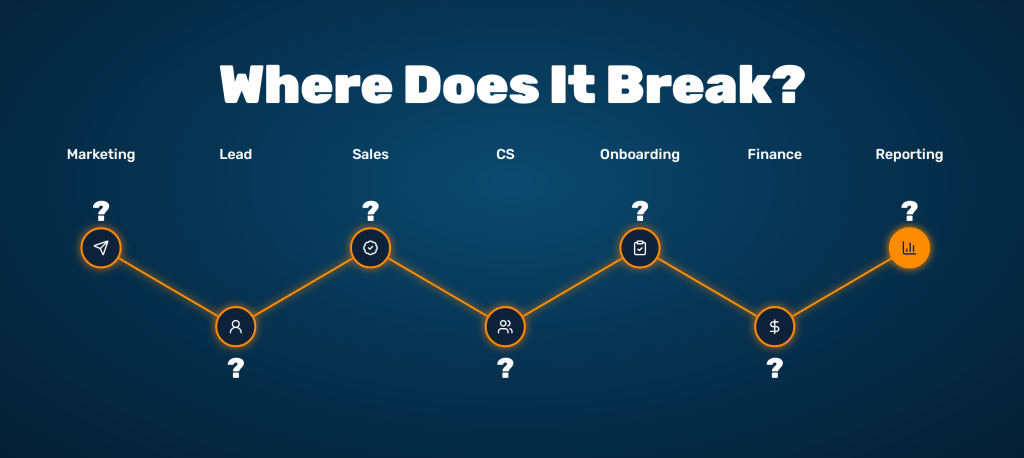
Before buying another round of revenue operations services, map the real path a deal takes from first contact to closed revenue, including every point where a person has to reconcile a number by hand. A System Automation Engagement map, or SAE Map, gives you a structured way to lay that groundwork before a vendor proposes anything.
2. Fix the Worst Handoff First
Once the map shows where deals stall, fix that one connection before scoping a larger engagement. Automating one feed keeps it in sync and can show whether the pipeline issue was a process gap or a data gap.
3. Keep CRM, Forecasting, and Finance Reading From the Same Data
A governed data hub that keeps the CRM, the forecasting model, and finance systems aligned is what prevents the pipeline-to-revenue mismatch in the first place. That risk shows up most at the handoff into finance, where direct point-to-point connections tend to fail silently after a platform update, and nobody notices until the quarter-end numbers don’t reconcile.
Common Questions About Revenue Operations Services and Pipeline Management
What Are Revenue Operations Services?
Revenue operations services align how sales, marketing, and customer success plan, measure, and operate around one shared set of data and definitions. For pipeline management specifically, that usually means CRM data governance, stage design, forecasting alignment, automation, and decision governance, delivered individually or as part of a larger engagement.
Do Revenue Operations Services Replace a RevOps Hire?
Most organizations use both. They pair an internal RevOps lead or ops generalist with outside services for specialized work, like data architecture or automation builds, that a single internal hire doesn’t have time to take on alone.
How Much of a Pipeline Problem Is Really a Data Problem?
Look at whether deals stall in the same stage past a normal cycle, whether the forecast changes depending on who presents it, and whether reps retype the same deal information in more than one system. If the answer is yes to any of those, a new revenue operations service inherits that gap.
Which Revenue Operations Service Should You Buy First?
Start with whichever one fixes the worst handoff. A diagnostic engagement that maps the pipeline first is usually what tells you which service matters most.
How Do You Know If Your Pipeline Management Problem Needs a New Service?
If the gap traces back to data nobody trusts, a new revenue operations service purchase repeats the same problem under a different name. A revenue diagnostic is a good place to talk through where that gap starts before you commit to a new engagement.
See Where Your Pipeline Data Breaks Down
Before you buy another revenue operations service, take a closer look at how a deal moves through the systems you already run.