




























Where Can I Find ERP Implementation Experts for Financial Services Firms?
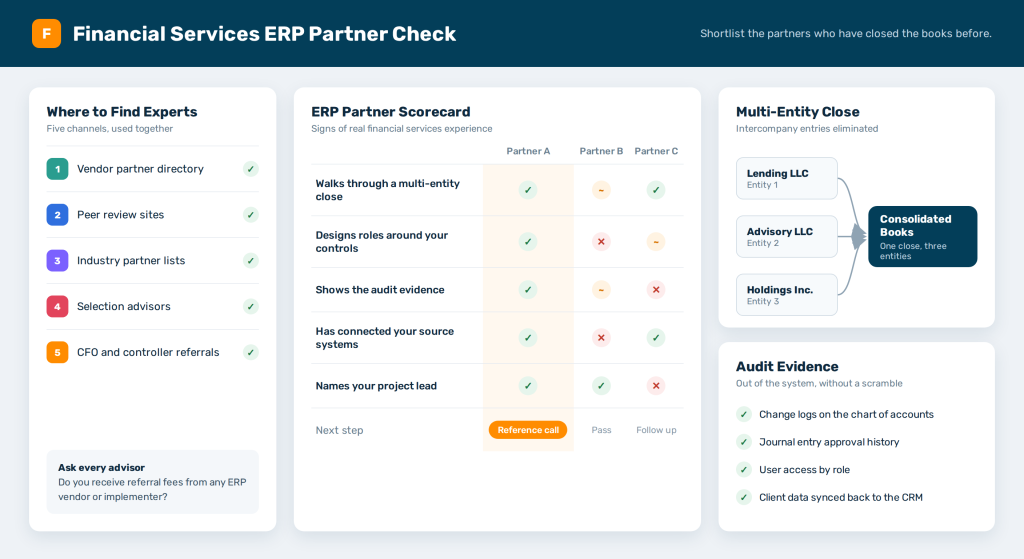
ERP implementation experts for financial services firms are easiest to find through five channels. Vendor partner directories, peer review sites, industry partner lists, selection advisors, and referrals from other finance leaders all produce qualified names.
Finding names is the easy part. Every partner on those lists will say they know financial services. The harder job is telling who has closed the books for a lender or a wealth manager. Some partners have only read about it.
Financial services puts demands on an enterprise resource planning (ERP) project that most industries never face. Multi-entity consolidation with intercompany eliminations is routine. Segregation of duties and audit trails have to satisfy auditors. Client and transaction data often starts in a core banking, portfolio, or customer relationship management (CRM) system. The ERP depends on data it doesn’t own.
What Financial Services Firms Need From ERP Implementation Experts
Financial services covers very different businesses, and each one leans on its ERP in a different way. The right partner for a lender may be the wrong one for an asset manager. Knowing which work matters most to your firm makes every partner conversation sharper.
Lenders
Loan-level detail usually lives in a loan servicing system, and the ERP receives summarized entries. The implementation work that matters most is the mapping between the two. Interest income, fees, and loan losses have to land in the right accounts every period. The partner should know how that feed gets reconciled.
Wealth and Asset Managers
Fee billing is often the hardest part. Fees tied to assets under management, tiered schedules, and household-level discounts have to flow from the portfolio system into invoices and revenue. Firms that run several funds or advisory entities also need clean consolidation across all of them.
Fintechs
Fintechs tend to process high transaction volumes through payment or banking partners, then post summaries to the ERP. They also add legal entities quickly as they enter new markets. A partner who has only implemented ERPs for stable, single-entity companies will struggle with that pace.
Whatever your segment, write down the two or three pieces of work that worry you most. They become the test you put to every partner on your shortlist.
Five Places to Find ERP Implementation Experts
Each channel below turns up a different kind of partner. Most firms get the best shortlist by using two or three of them together.
The ERP Vendor's Partner Directory
Every major ERP vendor keeps a list of certified partners, and it is the fastest place to start. NetSuite runs a partner finder covering several partner types, from solution providers and alliance partners to accounting firms and advisory firms. Sage points buyers to a Sage Intacct partner locator and runs a separate managed services program for accounting firms.
Microsoft grades its partners. Its Solutions Partner for Business Applications designation requires a capability score of at least 70 out of 100. The score is built from new customers, certified staff, and successful deployments.
A directory listing proves certification. It says nothing about financial services depth. Use the industry filter to narrow the list, then verify the claims yourself.
Peer Review Sites
Gartner Peer Insights tracks a market called Finance ERP Implementation Partners, with verified reviews of firms such as Accenture, Deloitte, KPMG, and PwC. You can filter reviews by industry and company size, which helps you see how a firm performed for organizations like yours.
These firms tend to fit large banks, insurers, and asset managers with complex global operations. A mid-market lender or advisory firm may find them more than it needs.
Industry-Focused Partner Lists
Some publishers rank partners by industry. The ERP Software Blog publishes Best Dynamics Partners for professional and financial services, an editorial list of eight Microsoft partners refreshed every six months. Its editors weigh industry expertise, case studies with measured outcomes, and the share of each partner’s business that comes from these sectors. The list states that placement is not paid.
A list like this gives a Dynamics buyer a short, pre-vetted starting point. Treat it as a shortlist and do your own checking.
Independent Selection Advisors
Selection advisors help you choose the ERP and the implementer before anyone configures anything. They earn their fee by knowing which partners have done work like yours.
Ask every advisor one direct question before you hire them. Do they receive referral fees from any ERP vendor or implementer? NetSuite, for one, runs a partner program for advisory and selection firms. A paid relationship doesn’t rule an advisor out, but you should know about it.
Other CFOs and Controllers
The most honest reviews come from finance leaders at firms like yours. Ask peers who recently replaced their ERP which partner they used, and what the first quarter-end close looked like afterward. Industry associations and CFO networks make those conversations easier to start.
A referral tells you how a partner behaves when something breaks. A directory never will.
Four Signs ERP Implementation Experts Have Done Financial Services Work
Claims are cheap in a sales cycle. Evidence is harder to fake. Ask each finalist to show you the four things below, with client names redacted if needed.
They Can Walk You Through a Multi-Entity Close
Ask them to describe a consolidation they set up for a firm with several legal entities. Listen for specifics about intercompany eliminations, currency translation, and who owned each step at month-end. A partner with real experience will talk about what went wrong the first time. A partner without it will talk about features.
They Design Roles Around Your Controls
Segregation of duties is where many ERP projects create audit problems without meaning to. Ask how they decide who can create a vendor, who can approve a payment, and who can post a journal entry. Strong partners map system roles to the controls your auditors test.
If your firm is public, or plans to be, this matters even more. Section 404 of the Sarbanes-Oxley Act (SOX) requires management to assess internal control over financial reporting in each annual report.
They Can Show the Audit Evidence the System Produces
Ask what an auditor will see. Change logs, journal entry approvals, and user access reports should all come out of the system without a scramble. Ask the partner for a redacted sample from a past project.
They Have Connected the Systems Where Your Data Starts
The ERP rarely holds client data first. A loan servicing system, a portfolio platform, or a CRM usually does. Ask which upstream systems the partner has integrated, and who owned the data mapping on those projects. If the answer is “the client,” expect to own it too.
These four signs separate ERP implementation experts from generalists who have added financial services to their website. A partner who can show all four is worth a reference call.
Watch for a few warning signs as well. A proposal that never mentions your auditors is one. Another is a project plan that treats data migration as a single line item. A third is a partner who can’t name the person who would lead your project. Each one suggests the financial services work will be learned on your time and budget.
The Work That Starts After Go-Live
Even the best ERP implementation experts scope their work around one system. The ERP gets configured, tested, and handed over. The places where it meets the rest of your stack are often left for later.
Picture a new advisory client. The relationship manager closes the deal in the CRM. Before finance can bill, compliance has to clear the account. The fee schedule has to match the signed agreement, and someone has to pick the right billing entity. The CRM partner configured the CRM. The ERP partner configured the ERP. Nobody owns the rule that connects them.
So people carry it by hand. Operations re-keys the client into the ERP. Compliance approves by email. Finance checks the fee schedule against a PDF. Each step works, and the whole thing depends on someone remembering to do it.
The ERP project ends at go-live. The handoffs between systems keep running every day after it.
The Centralized Data Hub System (CDHS) from Fruition works on those handoffs. CDHS sits between the systems you already run and acts as a translator. The CRM, the ERP, and your finance tools then follow the same rules.
You set each rule once. A client account reaches the ERP only after compliance approves it. The fee schedule comes straight from the signed agreement record. Approvals that need a person route to the right owner through the Decision Routing Cockpit, with the context attached.
CDHS works alongside whichever ERP and implementer you choose. The same approach helped a water infrastructure company running HubSpot and Zoho cut internal emails by 60%. It also eliminated duplicate entries between the two systems.
Many companies start smaller, with one Quick Data Flow (QDF) that fixes a single handoff, then expand as more rules come into view. If you are weighing who should own that work, our breakdown of integration partner types compares the options.
Before You Talk to Any ERP Implementation Experts
A little preparation makes every partner conversation more useful. Write down every system that holds client, transaction, or billing data, and how data moves between them today. Our SAE Map shows how we chart those flows.
Then list the decisions that cross systems, such as account approvals, fee changes, and entity assignments. Those decisions are where projects slip, and they are the first thing a strong partner will ask about.
Finally, put a number on the manual work you want to remove. The Data Leakage Calculator puts a number on what that manual work costs. Partners quote more accurately when they can see what the problem is worth.
Frequently Asked Questions
Where Can I Find ERP Implementation Experts for Financial Services Firms?
Start with the ERP vendor’s partner directory, then check peer review sites such as Gartner Peer Insights and industry-focused partner lists. Independent selection advisors and referrals from other CFOs fill in what directories can’t show.
Which ERP Systems Do Financial Services Firms Use?
Mid-market firms often run back-office finance on NetSuite, Sage Intacct, Workday, or Microsoft Dynamics 365. Banks and credit unions usually pair a general ERP with a separate core banking platform.
Do Financial Services Firms Need a Big Four Implementer?
Large, global institutions often choose a Big Four or global consultancy. Many mid-market lenders, advisors, and fintechs work with certified vendor partners who focus on their size and segment.
What Certifications Should an ERP Implementation Partner Have?
Look for the vendor’s own partner status, such as Microsoft’s Solutions Partner for Business Applications designation or a listing in NetSuite’s partner finder. Certification shows product skill, so verify financial services experience separately.
Can CDHS Work With Any ERP?
CDHS sits between your existing systems and applies the same business rules across them. It works alongside your ERP, your CRM, and your implementer.
Find Out What Happens to Your Data After Go-Live
A new ERP fixes the books. The handoffs around it still need an owner. Talk with us about where client and billing data still moves by hand. There is no obligation attached.